
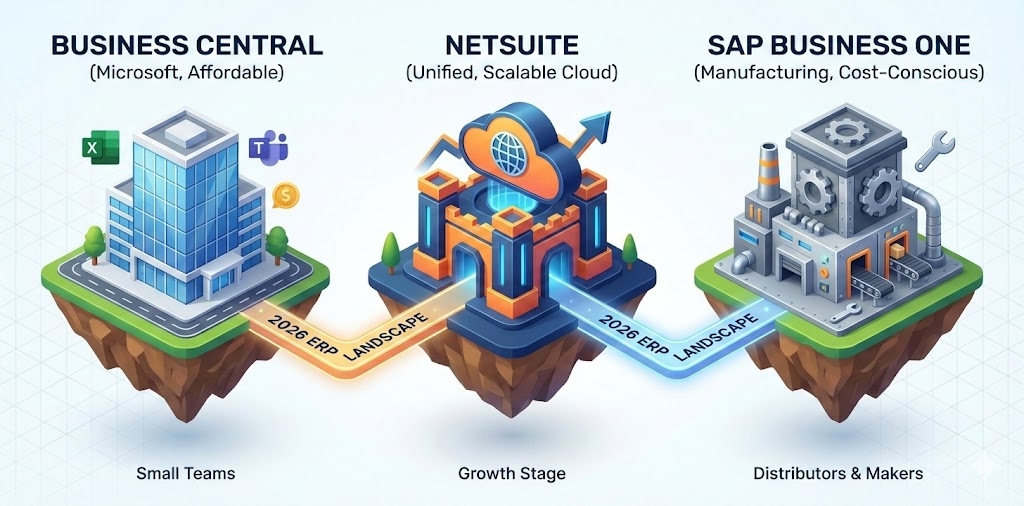
Three ERP solutions dominate the mid-market landscape in 2026: Microsoft Dynamics 365 Business Central, Oracle NetSuite, and SAP Business One. Each addresses different business profiles with distinct technical architectures and pricing models.
Business Central targets Microsoft-centric organizations prioritizing affordability and ease of use. Its per-user pricing (AUD $125-$179/month) makes it attractive for smaller teams already invested in Microsoft 365. Integration with Office, Teams, and Power BI is seamless, though CRM and HR capabilities require separate modules on different codebases.
NetSuite serves growth-stage and globally complex organizations requiring a unified, scalable platform. Its cloud-native architecture (built for cloud from inception in 1998) provides native multi-entity financial consolidation, integrated CRM, and comprehensive e-commerce capabilities. Higher costs (base fee plus per-user fees, typically AUD $1,400+/month) reflect its breadth, but the unified data model eliminates costly integrations between disconnected modules.
SAP Business One is the cost-conscious choice for manufacturers and distributors with straightforward operations. Its native Material Requirements Planning (MRP) and production planning are unmatched for small-scale manufacturing. Cloud licensing starts at EUR €38/month (AUD ~$63/month), and implementation costs (AUD $70k-$250k) depend heavily on scope.
Winner by organizational profile: - Best for Microsoft ecosystems: Business Central - Best for growth and complexity: NetSuite - Best for manufacturing/cost control: SAP Business One
1. Basic Information Comparison
| Dimension | Business Central | NetSuite | SAP Business One |
|---|---|---|---|
| Vendor | Microsoft | Oracle | SAP |
| Year Founded | 2018 (SaaS; evolved from NAV/Navision 1984) | 1998 (originally NetLedger) | 1990 (as SAP’s SMB solution) |
| Market Position | SMB / Lower mid-market cloud ERP | Growth-stage to mid-market unified ERP | SMB to lower mid-market manufacturing ERP |
| Global Customer Count | ~41,000+ | 41,000+ | 1,300+ (reference base); millions of licenses |
| Australian Presence | Strong (MS ecosystem) | Growing; established partner network | Established; 1,300+ global reference customers |
| Starting Price (AUD) | $125/user/month (Essentials) | $1,400/month base + $185/user | EUR €63/month cloud (Starter); EUR €4,500 perpetual |
| Deployment Options | Cloud-only (Azure) | Cloud-only (Oracle Cloud Infrastructure + NetSuite data centers) | Cloud (single-tenant hosted) + On-premise |
| Latest Version | Continuously updated (monthly releases) | Biannual updates (automatic; test environment available) | Version 10.0 (support ends Dec 2026); Version 11.0 announced |
| Architecture | Cloud-native modern (2018+) | Cloud-native legacy (1998; always cloud) | Hybrid (on-prem retrofitted to cloud; legacy technology) |
2. Core Features Comparison Matrix
| Feature Category | Business Central | NetSuite | SAP Business One |
|---|---|---|---|
| Financial Management | ✓ Strong (GL, AR, AP, budgeting, financial reporting) | ✓ Excellent (GL, AR, AP, revenue recognition, multi-currency) | ✓ Solid (GL, AR, AP, basic financial management) |
| Multi-Entity Consolidation | ✗ Separate entity databases; requires Power BI | ✓ Native OneWorld module (real-time consolidation) | ✗ Separate instances + external tools |
| Inventory Management | ✓ Distribution/warehouse (Essentials+) | ✓ Advanced inventory, lot/serial tracking, WMS module | ✓ Strong; designed for distribution/manufacturing |
| Supply Chain / Procurement | ✓ Basic (Essentials includes purchasing) | ✓ Comprehensive (procurement, supplier management) | ✓ Strong; includes supplier management |
| Manufacturing (MRP) | ✓ Premium edition includes MRP & capacity planning | ✓ MRP with demand planning, BOMs, routing | ✓✓ Best-in-class for SMB manufacturers; native MRP |
| Project Management | ✓ Basic project accounting (Essentials) | ✓ Native PSA (Professional Services Automation) | ✗ Limited; requires add-ons |
| CRM (Customer Relationship) | ✗ Basic contacts; full CRM requires Dynamics 365 Sales | ✓ Native integrated CRM | ✗ Limited; CRM requires add-ons |
| E-commerce Integration | ✗ Third-party integrations required | ✓ Native SuiteCommerce Plus | ✗ Requires Shopify/Magento integrations |
| Multi-Currency Support | ✓ Multiple currencies supported | ✓ 190+ currencies with automatic exchange rates | ✓ Supported but less robust |
| Multi-Company Management | ✗ Separate database per company | ✓ Unified database with real-time consolidation | ✗ Separate instance per company |
| Mobile App | ✓ Web-based responsive; Office mobile apps | ✓ Dedicated iOS & Android apps | ✗ Limited; VPN/RDP access |
| API & Integration | ✓ Open APIs; Power Automate & Power Platform | ✓ Extensive REST/SOAP APIs; 600+ integrations | ✗ Complex; partner-led integrations |
| Reporting & BI | ✓ Built-in reports + Power BI | ✓ SuiteAnalytics dashboards (real-time) | ✗ Requires Crystal Reports / external BI |
| Customization Level | ✓✓ Moderate (AL language, Power Automate) | ✓✓ High (SuiteScript, SuiteFlow, no-code options) | ✗ Low; complex SDK-based customization |
| Industry Solutions | ✓ Multiple pre-built industry packages | ✓ 20+ industry-specific SuiteSuccess solutions | ✓ Industry add-ons available |
| Data Storage & Compliance | ✓ Azure (GDPR, ISO, SOC 2) | ✓ Oracle Cloud (100+ country compliance) | ✓ Hosted with country-specific compliance |
| HR / Payroll | ✗ Separate Dynamics 365 HR; no native payroll | ✓ SuitePeople HR & Payroll | ✗ Limited; third-party solutions needed |
3. Implementation & Support Comparison
| Dimension | Business Central | NetSuite | SAP Business One |
|---|---|---|---|
| Average Implementation Timeline | 2-4 months (simple / standard scope) | 3-6 months typical; 100 days minimum (SuiteSuccess fast-track) | 2-4 months (8-16 weeks; standard scope) |
| Learning Curve | Low (Microsoft Office familiarity; intuitive UI) | Moderate to high (full ERP complexity; extensive features) | Moderate (traditional interface; learning resources available) |
| Partner Network in Australia | Large Microsoft ecosystem; 200+ certified partners | Established; 150+ certified partners globally | Strong; 100+ regional implementation partners |
| Support Quality | Microsoft direct support + partner ecosystem; active community | Oracle 24/7 direct vendor support; dedicated account management | Partner-dependent; SAP escalation available |
| Support Cost Model | Included in subscription; SLA-based tiers available | Included; 24/7 access with multiple SLA tiers | Partner-led support; variable pricing and quality |
| Update Frequency | Monthly continuous releases (automatic) | Biannual updates (automatic; sandbox testing) | Quarterly feature packs (manual deployment) |
| Customization Maintenance | Customizations carry forward automatically | Customizations preserved with cloud-native upgrades | Customizations must be retested after each update |
| Implementation Services Cost (AUD) | $4k-$25k (basic to moderate complexity) | $25k-$100k+ (complexity & multi-entity increase cost) | $70k-$250k (8-50 users; scope-dependent) |
4. Pricing Breakdown (Annual + Implementation, Year 1 Total)
Scenario 1: Small Business (10 Users)
| System | License Cost (AUD/year) | Implementation (AUD) | Year 1 Total | Notes |
|---|---|---|---|---|
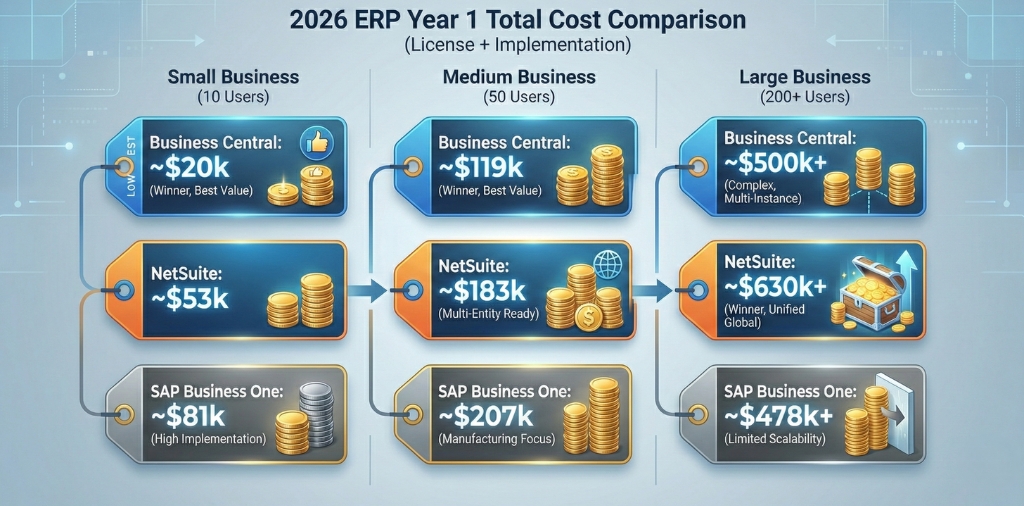
| Business Central Essentials | $15,000 (10 users × $125/mo × 12) | $5,000 | $20,000 | Lowest entry cost; strong Microsoft ecosystem advantage |
| NetSuite | $22,800 ($1,400 base × 12 + 10 users × $185/mo × 12) | $30,000 | $52,800 | More native functionality; higher upfront investment |
| SAP Business One Cloud | $11,400 (10 users × €91/mo × 12 ≈ AUD $188/mo) | $70,000 | $81,400 | Implementation-heavy; higher long-term support costs |
Scenario 2: Medium Business (50 Users)
| System | License Cost (AUD/year) | Implementation (AUD) | Year 1 Total | Notes |
|---|---|---|---|---|
| Business Central Premium (Manufacturing) | $107,400 (50 users × $179/mo × 12) | $12,000 | $119,400 | Scales well; manufacturing features included; strong Office integration |
| NetSuite | $133,200 ($1,400 base × 12 + 50 users × $185/mo × 12) | $50,000 | $183,200 | Native multi-entity consolidation; broad modules; e-commerce ready |
| SAP Business One Cloud | $57,000 (50 users × €91/mo × 12 ≈ AUD $188/mo) | $150,000 | $207,000 | Strong manufacturing depth; lower license cost but heavy implementation |
Winner for Medium Business: Business Central (best value); NetSuite if multi-entity/global; SAP B1 if manufacturing-heavy
Scenario 3: Large Business (200 Users, Multi-Entity)
| System | License Cost (AUD/year) | Implementation (AUD) | Year 1 Total | Notes |
|---|---|---|---|---|
| Business Central Premium (Multi-Instance) | $429,600 (200 users × $179/mo × 12) + multi-instance overhead | $75,000+ | $504,600+ | Separate instances per entity; scaling costs and operational complexity increase |
| NetSuite | $532,800 ($1,400 base × 12 + 200 users × $185/mo × 12 + modules) | $100,000 | $632,800 | Unified global platform; OneWorld consolidation removes re-implementation complexity |
| SAP Business One | $228,000 (200 users × €91/mo × 12) | $250,000+ | $478,000+ | Works if entity scope is narrow; true multi-entity setups can push costs higher |
Winner for Medium Business: Business Central (best value); NetSuite if multi-entity/global; SAP B1 if manufacturing-heavy
5. Detailed Functional Analysis
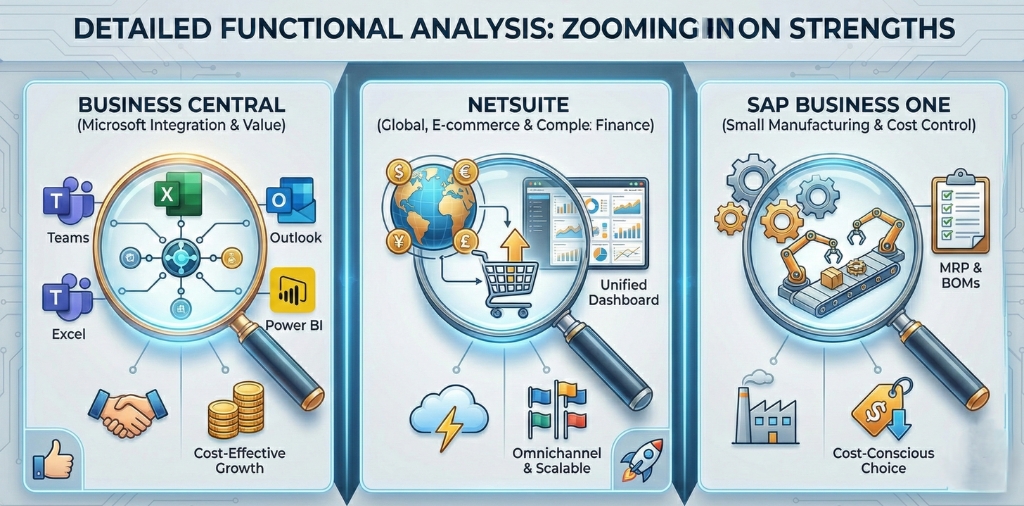
Microsoft Ecosystem Integration Business Central was designed for organizations already committed to Microsoft 365. Teams, Outlook, Excel, and Power BI integrate seamlessly without middleware. Users can edit ERP data directly in Excel, sync purchase orders in Outlook, and generate Power BI dashboards without IT intervention. This native integration reduces friction for finance teams accustomed to Microsoft tools.
Cost-Effective Growth With per-user pricing ($125-$179/month) and no platform base fee, Business Central scales linearly. A company growing from 20 to 50 users adds predictable license costs without surprise module fees. Implementation timelines (2-4 months) are shorter than competitors, meaning faster ROI and lower initial consulting spend.
Manufacturing (Premium Edition) The Premium license ($179/user/month) includes native production orders, MRP, capacity planning, and demand forecasting-sufficient for light manufacturing or assembly operations. While less robust than SAP B1’s MRP, it’s integrated into the same system as financials and inventory, reducing data silos.
Limitations – Fragmented Architecture: CRM and HR reside in separate Dynamics 365 applications on different codebases. A unified customer view requires manual data integration or Microsoft Dataverse configuration, adding complexity. – Scalability Ceiling: Business Central is designed for organizations up to mid-market (~300 users, though no hard limit stated). Organizations with hundreds of active users or complex multi-subsidiary structures may encounter functional limitations. – Module Costs: Advanced features (e-commerce, advanced supply chain) require AppSource add-ons at additional cost, eroding the “simple pricing” advantage.
Multi-Subsidiary and Global Operations NetSuite’s OneWorld module is unmatched for real-time multi-entity financial consolidation. A multinational with subsidiaries in the UK (GBP), Australia (AUD), and Singapore (SGD) can operate from one unified database, with automatic daily exchange rate feeds, subsidiary-specific tax rules, and consolidated reporting at the parent level-all without data silos or manual consolidation. For CFOs managing complex intercompany transactions or transfer pricing, this is game-changing.
E-commerce and Omnichannel Retail NetSuite’s SuiteCommerce Plus is a native omnichannel platform. Companies managing direct-to-consumer channels, marketplaces (Amazon, Shopify, etc.), and physical retail can synchronize inventory, orders, and fulfillment across all channels from one system. This is critical for fashion, consumer goods, or high-growth e-commerce businesses where split inventory visibility leads to overselling or stockouts.
Complex Financial Operations NetSuite’s revenue recognition engine natively handles subscription billing, multi-element arrangements, and GAAP/IFRS compliance without third-party apps. For SaaS companies or complex contract manufacturers, this reduces dependency on bolt-on accounting solutions.
Predictable, Scalable Growth NetSuite’s architecture scales from startups to billion-dollar enterprises without re-implementation. Companies can start with core ERP and incrementally add CRM, inventory, or PSA modules-all on the same data model. This “grow without migrating” philosophy is rare and valuable for venture-backed or high-growth firms.
Limitations – Higher Cost: Base fees ($1,400/month) plus per-user costs and module fees make NetSuite 2-3× more expensive than competitors for small deployments. ROI requires scale or operational complexity that justifies the investment. – Customization Complexity: While SuiteCloud is powerful, deep customizations require SuiteScript expertise or consultants, not business-user no-code tools. This can extend implementation timelines and increase costs. – Learning Curve: The breadth of functionality means new users face a steeper learning curve than simpler systems like Business Central. Training is essential, and user adoption challenges are common in smaller organizations.
Small-Scale Manufacturing SAP B1’s native Material Requirements Planning (MRP) is best-in-class for SMB manufacturers. Production orders, bill of materials (BOMs), demand planning, and inventory allocation are all tightly integrated and optimized for manufacturing workflows. A food manufacturer or machinery fabricator with 20-50 employees finds B1’s manufacturing depth perfect without the complexity of enterprise ERPs.
Cost-Conscious Operations Cloud licensing starting at EUR €38/month (AUD ~$63/month) for a Starter package makes B1 the cheapest entry point. Perpetual licenses (EUR €2,700 per user on-premise) appeal to organizations wanting to own software and avoid ongoing SaaS fees. For budget-constrained SMBs, B1 is often the “best bang for buck” in manufacturing and distribution.
Established SAP Ecosystem Users Companies already using SAP for other business units or requiring integration with SAP SuccessFactors (HR) or SAP Analytics Cloud find B1 a natural fit. SAP’s global partner ecosystem and compliance/localization support for 100+ countries make B1 attractive for multinationals seeking consistency.
Limitations – Scalability Ceiling: B1 practically caps at 50-350 concurrent users. Performance degrades and data management becomes unwieldy beyond that point. Growing companies face costly migration to SAP S/4HANA or another ERP-a disruptive, expensive transition. – Multi-Entity Complexity: Companies with multiple subsidiaries or locations must maintain separate B1 instances, creating data silos and manual consolidation. Each instance is a separate cost and support burden. – Legacy Technology: B1 was retrofitted to the cloud, not built for cloud from inception. Automatic upgrades are absent; quarterly feature packs require manual deployment and testing, placing the burden on IT teams. – Support Model: Support is partner-dependent, meaning quality varies. A weak partner leaves you vulnerable; changing partners mid-project is disruptive.
6. Winner by Category
| Category | Winner | Rationale |
|---|---|---|
| Best Overall Value | Business Central | Lowest licensing cost ($125/user); fast implementation (2-4 months); strong SMB feature set offsets higher upfront costs. |
| Best for Manufacturing | SAP Business One | Native MRP, production planning, and demand forecasting ideal for SMB manufacturers. |
| Best for Retail / E-commerce | NetSuite | Native omnichannel with SuiteCommerce Plus, multi-warehouse inventory, and unified fulfillment. |
| Best for Professional Services | Business Central / NetSuite | Business Central offers native project accounting; NetSuite provides a comprehensive PSA module. |
| Best Cloud Solution | NetSuite | True cloud-native ERP with automatic biannual updates, multi-tenant architecture, and no on-premise legacy. |
| Best Scalability | NetSuite | Scales from startup to enterprise without re-implementation; OneWorld enables global expansion. |
| Best ROI for Cost | Business Central | Lowest per-user cost, fastest implementation, and strong value for 10-100 user businesses. |
| Best for Global / Multi-Subsidiary | NetSuite | Native OneWorld consolidation, local tax rules, and automatic currency conversion; fewer workarounds required. |
| Best for Australian Market | Business Central | Strong Microsoft ecosystem, abundant local partners, and seamless Microsoft 365 integration. |
| Best for System Integration | Business Central / NetSuite | BC integrates natively with Microsoft tools; NetSuite offers 600+ SuiteApps and extensive APIs. |
7. Decision Framework
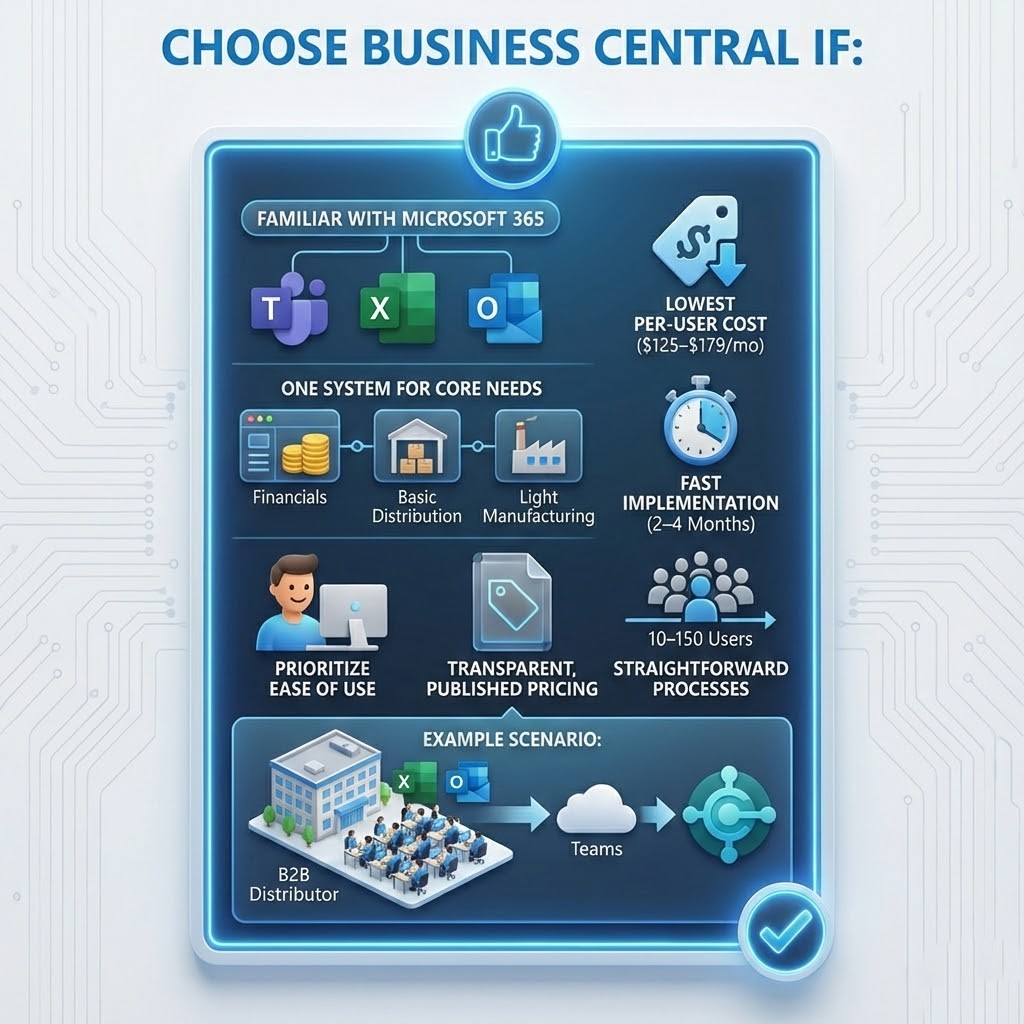
- Your team is familiar with Microsoft 365 (Office, Teams, Outlook).
- You want the lowest per-user cost ($125-$179/month).
- You need financials, basic distribution, and light manufacturing on one system.
- Implementation speed is critical (target 2-4 months).
- You prioritize ease of use over breadth of functionality.
- You want transparent, published pricing with no surprise module fees.
- Your organization has ~10-150 users and straightforward business processes.
Example: A mid-sized B2B distributor with a 40-person finance/operations team using Excel and Outlook, looking to replace legacy accounting software and integrate with Teams.
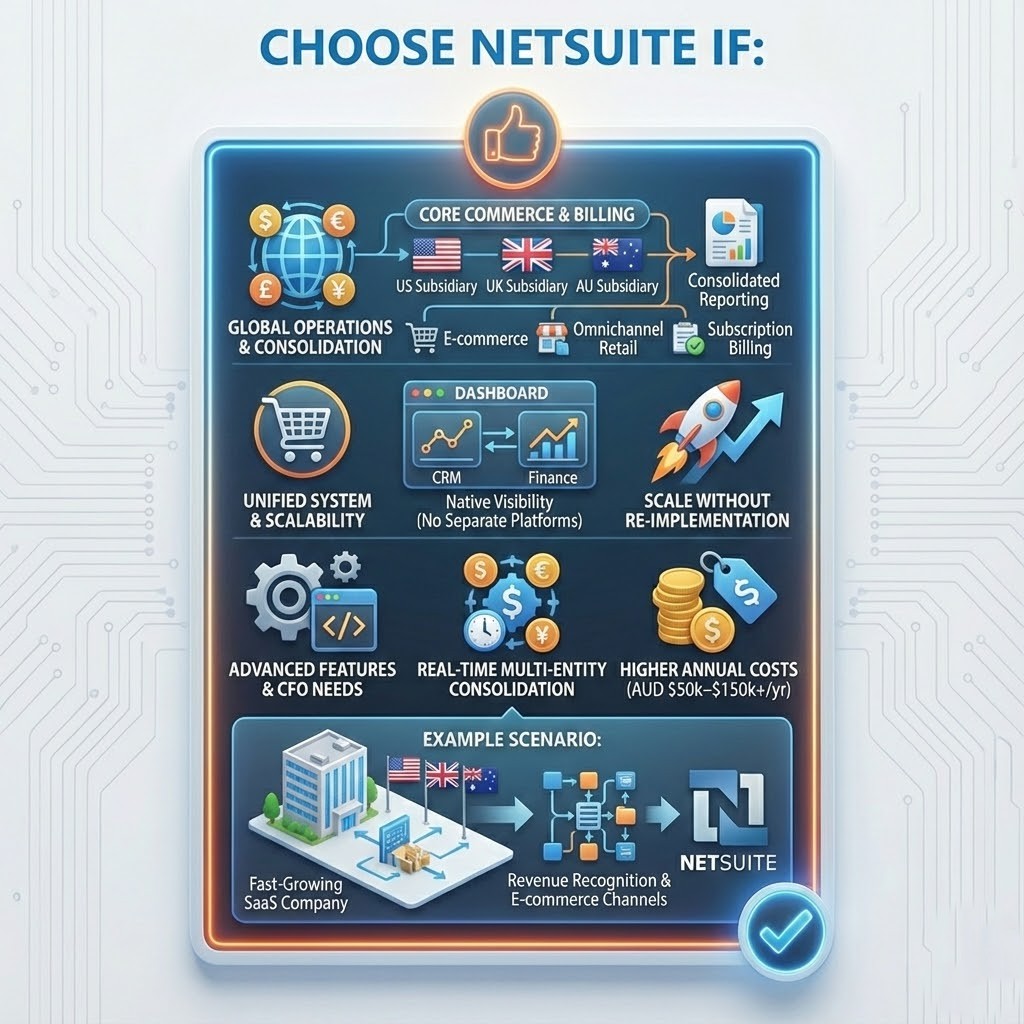
- You operate across multiple countries/subsidiaries requiring consolidated financial reporting.
- E-commerce, omnichannel retail, or subscription billing are core to your business.
- You need native CRM and financial visibility in one system (no separate platforms).
- You plan significant growth and want to scale without re-implementation.
- Advanced customization, reporting, and API integration are priorities.
- Your CFO requires real-time multi-entity consolidation and multi-currency operations.
- Total addressable market and business complexity justify higher annual costs (AUD $50k-$150k+/year).
Example: A fast-growing SaaS company operating in US/UK/Australia with complex revenue recognition requirements, e-commerce channel sales, and subsidiary management needs.
- You operate across multiple countries/subsidiaries requiring consolidated financial reporting.
- E-commerce, omnichannel retail, or subscription billing are core to your business.
- You need native CRM and financial visibility in one system (no separate platforms).
- You plan significant growth and want to scale without re-implementation.
- Advanced customization, reporting, and API integration are priorities.
- Your CFO requires real-time multi-entity consolidation and multi-currency operations.
- Total addressable market and business complexity justify higher annual costs (AUD $50k-$150k+/year).
Example: A fast-growing SaaS company operating in US/UK/Australia with complex revenue recognition requirements, e-commerce channel sales, and subsidiary management needs.
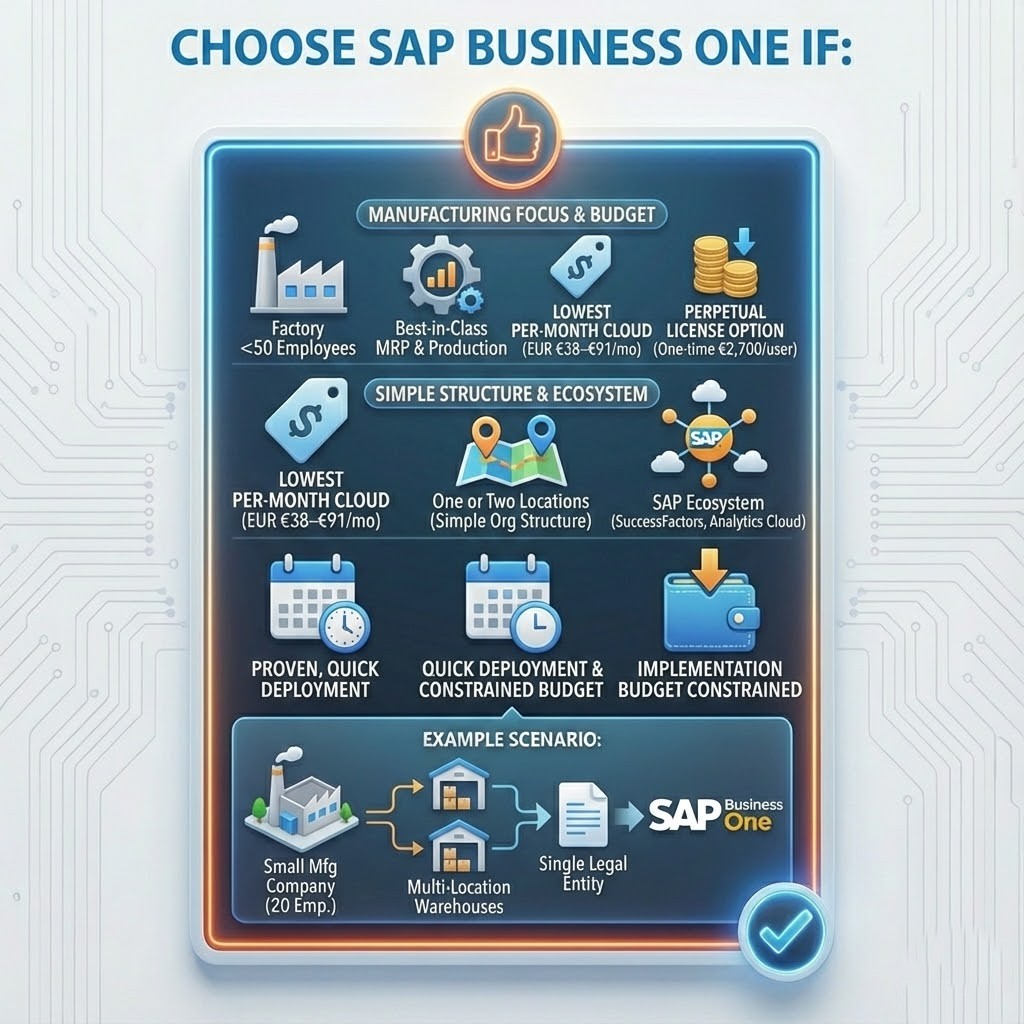
- You are a manufacturer with <50 employees needing best-in-class MRP and production planning.
- Budget is the primary constraint; you want lowest per-month licensing (EUR €38-€91/month cloud).
- You prefer perpetual licenses (one-time EUR €2,700 per user) over recurring SaaS fees.
- Your business operates in one or two locations with simple organizational structure.
- You are integrated with SAP’s broader ecosystem (e.g., already use SuccessFactors, Analytics Cloud).
- Implementation budget is constrained; you value proven, quick deployment (2-4 months for standard scope).
Example: A small manufacturing company (20 employees) producing industrial components, with multi-location warehouses but single legal entity, looking for strong MRP and inventory control.
8. Real User Reviews (G2 2025)
NetSuite (4.1/5, 215+ verified reviews)
Positive Review (Actual User): > “I love NetSuite’s ease of use, which simplifies complex tasks and helps me navigate the platform easily. Its ability to configure according to my specific needs makes it a powerful tool for managing our business. The platform integrates well with other applications and offers flexibility during implementation to match business requirements.”
Critical Review (Actual User): > “Due to the depth of features, new users may face a learning curve, which can affect ease of use during the initial phase. Implementation timelines may extend when advanced customizations or multiple integrations are involved. System performance optimization and more intuitive configuration options would help ensure smoother daily usage.”
Business Central (4.4/5, 890+ verified reviews)
Positive Review (Actual User): > “This platform offers the most advanced and effective financial resources of its kind. The performance of all its virtual functions is exceptional. My business has improved the management and accounting of all its income, facilitating the supervision of each of our financial transactions.”
User Sentiment: Strong satisfaction among Microsoft ecosystem users; consistent praise for cost-effectiveness and ease of adoption for small/mid-sized businesses.
SAP Business One (Customization: 8.2/5 on G2, 150+ verified reviews)
Positive Review (SAP B1 User): > “SAP Business One offers strong customization capabilities, particularly for manufacturing and distribution workflows. The MRP functionality is industry-leading for SMBs, and the cost-per-user is competitive.”
Critical Review: > “Implementation requires experienced SAP partners; support quality varies significantly by partner. Scalability is limited beyond ~50 concurrent users, and multi-entity operations are complex compared to newer cloud-native solutions.”
9. Implementation & Pricing Summary Table (Year 1, AUD)
| Business Size | Recommended System | License Cost | Impl. Cost | Year 1 Total | Rationale |
|---|---|---|---|---|---|
| 10 users | Business Central | $15,000 | $5,000 | $20,000 | Lowest cost; strong feature set; seamless Microsoft integration. |
| 10 users (manufacturing) | SAP Business One | $11,400 | $70,000 | $81,400 | Best choice if MRP is critical; higher implementation offsets lower license. |
| 50 users | Business Central | $107,400 | $12,000 | $119,400 | Best value at scale; Premium includes manufacturing and advanced features. |
| 50 users (multi-entity) | NetSuite | $133,200 | $50,000 | $183,200 | OneWorld native consolidation eliminates separate instances. |
| 200+ users (global) | NetSuite | $532,800+ | $100,000+ | $632,800+ | Unified global platform with no re-implementation as the business scales. |
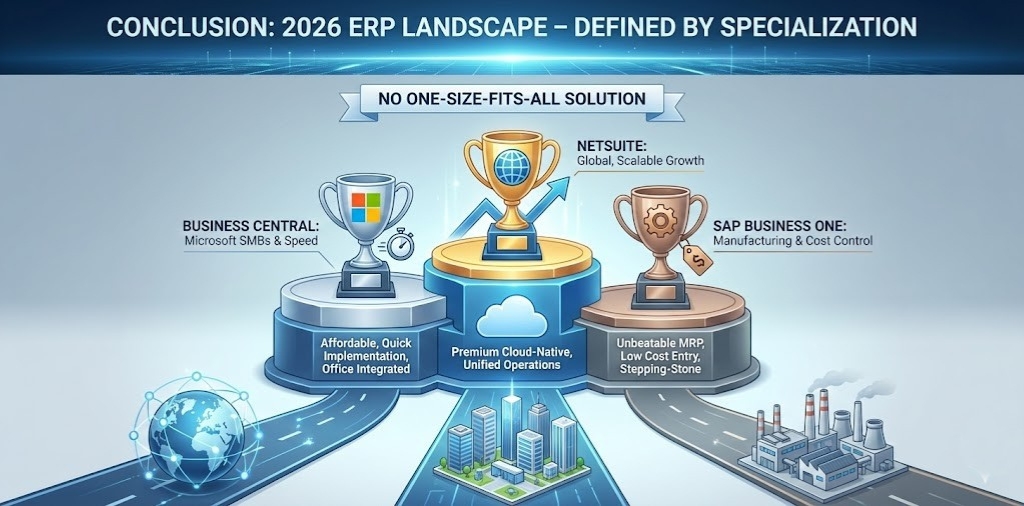
Conclusion: 2026 ERP Landscape
The 2026 ERP market is defined by specialization, not one-size-fits-all solutions.
Business Central wins for Microsoft-centric SMBs seeking affordability and speed. Its transparent pricing, quick implementation, and native Office integration make it the safe choice for organizations already invested in Microsoft. The tradeoff is limited multi-entity functionality and modular architecture (separate CRM/HR).
NetSuite commands premium pricing justified by true cloud-native architecture, unified global operations, and seamless omnichannel capabilities. It’s the platform for fast-growing, complex, or multi-national organizations. Its cost is steep for startups but diminishes on a per-dollar-of-value basis as business complexity grows.
SAP Business One holds ground in manufacturing and cost-conscious SMBs, where native MRP and low per-month licensing ($63-$188/month cloud) remain unbeatable. However, it’s a stepping-stone ERP; companies outgrow it at 50-100 users or in multi-entity scenarios.
For Australian businesses in 2026: Business Central dominates the SMB segment due to strong Microsoft presence and affordability. NetSuite captures growth-stage and multinational companies. SAP B1 thrives among manufacturers. No single system suits all; match your choice to your operational complexity, budget, and growth trajectory.
FAQs (Frequently Asked Questions)
Which system offers the best value for a 50-person company?
Business Central (Premium) at AUD $119,400 Year 1 total (license + implementation). It offers manufacturing features, Microsoft integration, and solid support at the lowest total cost. NetSuite is more expensive (AUD $183,200 Year 1) but justified if multi-entity consolidation, e-commerce, or global operations are priorities. SAP B1 sits between (AUD $207,000 Year 1) and is best if manufacturing (MRP) is the core focus.
Can I upgrade from Business Central to NetSuite later without re-implementation?
Technically yes, but it’s disruptive. You’d need to migrate data from BC to NetSuite, reconfigure workflows, and retrain users. The migration effort is typically 2-4 months. Unlike Business Central → larger Dynamics 365 upgrades, there’s no vendor-supported migration path. Plan accordingly if growth to multi-entity or global operations is anticipated; NetSuite may be the better starting point.
Does SAP Business One support multi-currency transactions?
Yes, but not as robustly as NetSuite. B1 supports multi-currency in invoicing and reporting, but lacks automatic daily exchange rate feeds and real-time consolidation across entities. If your business has significant cross-border transactions (US/UK/AUS subsidiaries), NetSuite’s automated currency handling and subsidiary management is superior.
Which system has the shortest implementation timeline?
Business Central (2-4 months typical). NetSuite’s SuiteSuccess fast-track can achieve “technical go-live” in 100 days (~3 months), but full deployment is typically 4-6 months. SAP B1 is comparable (2-4 months) but partner-dependent. For speed, Business Central edges ahead due to simpler scope and abundant Microsoft tooling.
Can I use Business Central with separate CRM without integration headaches?
Yes, but expect manual data sync or middleware costs. If you use Dynamics 365 Sales (Microsoft’s CRM), integration is simpler (both on Microsoft Dataverse). If you use a non-Microsoft CRM (HubSpot, Salesforce), you’ll need custom integrations or middleware tools, adding cost and complexity. NetSuite avoids this by including CRM natively on one database.
Which system is best for e-commerce businesses?
NetSuite, hands-down. SuiteCommerce Plus is a native omnichannel platform that syncs inventory, orders, and fulfillment across Shopify, Amazon, and direct-to-consumer channels from a single database. Business Central can integrate with e-commerce platforms via Power Automate or third-party connectors, but it requires more manual configuration. SAP B1 requires external e-commerce platforms and manual order imports.
What happens when a SAP Business One partner goes out of business?
You’re at risk. Unlike NetSuite (direct vendor support) or Business Central (Microsoft support), B1 support is entirely partner-dependent. Changing partners mid-project is disruptive; the new partner must understand your customizations. To mitigate, choose an SAP-certified partner with multi-year stability and ensure code documentation is robust. Escalation to SAP for critical issues is possible but slow.
Is NetSuite’s price worth the cost for a 20-person company?
Unlikely. At 20 users, NetSuite costs ~AUD $35,000-$40,000/year (license + support), plus $30k-$50k implementation. Business Central costs ~$40,000 Year 1 total, with similar capability at a fraction of the price. NetSuite’s value emerges at 50+ users, especially if multi-entity consolidation, e-commerce, or global tax complexity is present.
Source Citations
[1] NetSuite global customer count: Oracle NetSuite official (2025)
[2] Business Central pricing (AUD): Microsoft official; DynamicsSquare AU white paper
[3] SAP Business One pricing: SAPB1.com.au; Business One Consultancy (Oct 2025)
[4] Implementation timelines: Vendor materials + G2 user reviews; Leverage Technologies (AU) SAP B1 case studies
[5] G2 ratings: NetSuite 4.1/5 (215+ reviews); Business Central 4.4/5 (890+ reviews); SAP B1 Customization 8.2/5
[6] Multi-entity consolidation: NetSuite vs SAP B1 vs Business Central comparison whitepapers
[7] Manufacturing (MRP) benchmarking: HouseBlend.io ERP comparison; CrossCountry Consulting SAP B1 vs NetSuite
[8] Australian market presence: Envertis, DynamicsSquare AU, SAPB1.com.au partner directories

Shadab Alam
Founder of CodXpert • Co-Founder of Anterpreneur & Niagara Print Express
Shadab Alam is an entrepreneur, technology strategist, and the Founder of CodXpert, as well as Co-Founder of Anterpreneur and Niagara Print Express (NPE). With expertise in software engineering, artificial intelligence, SEO, digital transformation, and business strategy, he empowers businesses to innovate, automate processes, and accelerate sustainable growth through modern technology and data-driven solutions.
