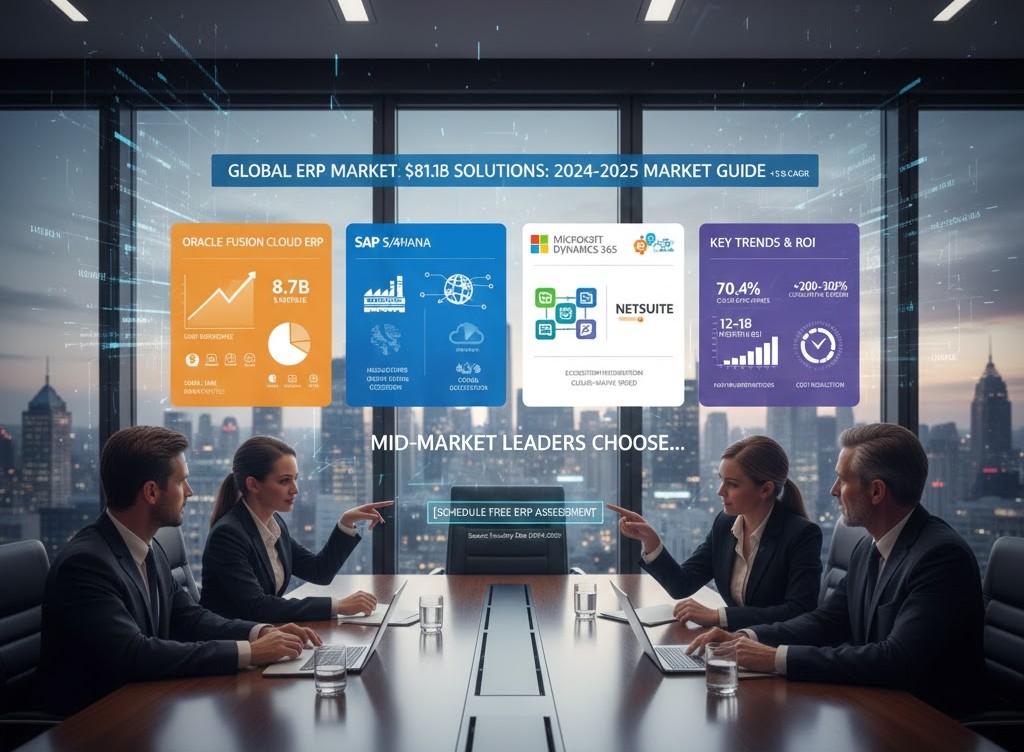
Over 50 million organizations worldwide leverage ERP systems to manage their business operations, with the global ERP market valued at $81.15 billion in 2024—and projected to reach $229.79 billion by 2032 at a remarkable 13.8% compound annual growth rate. In a dramatic industry shift, Oracle surpassed SAP as the No. 1 ERP vendor for the first time in 2024, capturing $8.7 billion in ERP revenues compared to SAP’s $8.6 billion, ending three decades of SAP dominance in the enterprise resource planning space. This transformation underscores how the ERP landscape continues evolving, with cloud solutions now commanding 70.4% of all ERP deployments globally.
Retail & Ecommerce Industry
| Company Name | Website | Country | Annual Revenue | ERP Solution |
|---|---|---|---|---|
| Walmart Inc. | walmart.com | United States | $648.1 Billion | SAP S/4HANA |
| Costco Wholesale | costco.com | United States | $242.3 Billion | SAP S/4HANA |
| Carrefour | carrefour.com | France | $102.5 Billion | SAP S/4HANA |
| Kroger | kroger.com | United States | $150.0 Billion | Oracle Cloud ERP |
| Albertsons | albertsons.com | United States | $79.2 Billion | Oracle Cloud ERP |
| Schwarz Group | schwarz.com | Germany | $129.0 Billion | SAP S/4HANA |
| Tesco | tesco.com | United Kingdom | $77.6 Billion | Oracle Cloud ERP |
| Lowe’s | lowes.com | United States | $86.4 Billion | Oracle Cloud ERP |
Manufacturing & Industrial Sector
| Company Name | Website | Country | Annual Revenue | ERP Solution |
|---|---|---|---|---|
| Toyota Motor | toyota.com | Japan | $410.9 Billion | SAP S/4HANA |
| Volkswagen Group | volkswagen.com | Germany | $257.0 Billion | SAP S/4HANA |
| Bosch Group | bosch.com | Germany | $102.8 Billion | SAP S/4HANA |
| Siemens | siemens.com | Germany | $84.3 Billion | SAP S/4HANA |
| Accenture | accenture.com | Ireland | $64.9 Billion | SAP S/4HANA |
| IBM | ibm.com | United States | $61.9 Billion | SAP S/4HANA Cloud |
| Microsoft | microsoft.com | United States | $245.1 Billion | SAP S/4HANA Cloud |
Consumer Packaged Goods & Beverage
| Company Name | Website | Country | Annual Revenue | ERP Solution |
|---|---|---|---|---|
| The Coca-Cola Company | coca-cola.com | United States | $45.8 Billion | SAP S/4HANA |
| PepsiCo | pepsico.com | United States | $91.5 Billion | SAP S/4HANA |
| Grupo Bimbo | grupobimbo.com | Mexico | $23.9 Billion | Oracle Cloud ERP |
| Unilever | unilever.com | United Kingdom | $67.5 Billion | SAP S/4HANA |
| Nestlé | nestle.com | Switzerland | $98.5 Billion | SAP ERP |
| Mondelez International | mondelezinternational.com | United States | $31.0 Billion | SAP S/4HANA |
| Danone | danone.com | France | $29.0 Billion | SAP ERP |
| General Mills | generalmills.com | United States | $19.0 Billion | SAP S/4HANA |
Financial Services & Banking Industry
| Company Name | Website | Country | Annual Revenue | ERP Solution |
|---|---|---|---|---|
| Bank of America | bofa.com | United States | $101.9 Billion | Oracle Cloud ERP |
| JPMorgan Chase | jpmorganchase.com | United States | $176.5 Billion | Oracle Fusion Cloud ERP |
| Sumitomo Mitsui | smbc.co.jp | Japan | $68.05 Billion | Oracle ERP |
| ICBC | icbc.com.cn | China | $95.2 Billion | Custom SAP Integration |
| UBS | ubs.com | Switzerland | $54.4 Billion | Oracle ERP |
| Goldman Sachs | goldmansachs.com | United States | $67.5 Billion | Custom Oracle Integration |
Healthcare & Pharmaceuticals Sector
| Company Name | Website | Country | Annual Revenue | ERP Solution |
|---|---|---|---|---|
| National Health Service (NHS) | nhs.uk | United Kingdom | $200.0 Billion | Oracle Cloud ERP |
| Humana Inc. | humana.com | United States | $117.8 Billion | Oracle Cloud ERP |
| UnitedHealth Group | unitedhealthgroup.com | United States | $400.3 Billion | Microsoft Dynamics 365 |
| Cigna | cigna.com | United States | $247.1 Billion | Oracle Fusion Cloud ERP |
| Pifzer | pfizer.com | United States | $81.3 Billion | SAP ERP & Ariba |
| Johnson & Johnson | jnj.com | United States | $94.9 Billion | Oracle ERP |
| AbbVie | abbvie.com | United States | $56.0 Billion | SAP S/4HANA |
| Merck & Co. | merck.com | United States | $59.3 Billion | SAP S/4HANA |
Telecommunications & Media Industry
| Company Name | Website | Country | Annual Revenue | ERP Solution |
|---|---|---|---|---|
| AT&T | att.com | United States | $122.3 Billion | Oracle Cloud ERP |
| Verizon Communications | verizon.com | United States | $144.0 Billion | SAP ERP |
| Deutsche Telekom | telekom.com | Germany | $112.5 Billion | SAP S/4HANA |
| Vodafone | vodafone.com | United Kingdom | $62.3 Billion | Oracle ERP |
| Hearst Communications | hearst.com | United States | $12.0 Billion | Oracle Cloud ERP |
| Netflix | netflix.com | United States | $37.3 Billion | Custom Cloud Solutions |
| Comcast | comcast.com | United States | $121.4 Billion | Custom ERP Systems |
Logistics, Transportation & Supply Chain
| Company Name | Website | Country | Annual Revenue | ERP Solution |
|---|---|---|---|---|
| FedEx Corporation | fedex.com | United States | $87.8 Billion | Oracle Cloud ERP |
| United Parcel Service (UPS) | ups.com | United States | $91.0 Billion | Oracle Cloud ERP |
| Deutsche Post DHL | dpdhl.com | Germany | $88.0 Billion | SAP S/4HANA |
| Amazon Logistics | amazon.com | United States | $575.0 Billion | Proprietary + SAP ERP |
| Maersk Line | maersk.com | Denmark | $61.5 Billion | Oracle ERP |
| XPO Logistics | xpo.com | United States | $19.3 Billion | SAP ERP |
| J.B. Hunt Transport | jbhunt.com | United States | $10.2 Billion | NetSuite ERP |
Energy, Oil & Gas Industry
| Company Name | Website | Country | Annual Revenue | ERP Solution |
|---|---|---|---|---|
| Saudi Aramco | aramco.com | Saudi Arabia | $160.0 Billion | Oracle ERP |
| ExxonMobil | exxonmobil.com | United States | $329.4 Billion | Oracle ERP |
| Shell | shell.com | United Kingdom | $383.0 Billion | SAP ERP |
| BP | bp.com | United Kingdom | $180.5 Billion | Oracle ERP |
| TotalEnergies | totalenergies.com | France | $237.0 Billion | SAP S/4HANA |
| Chevron | chevron.com | United States | $211.6 Billion | Oracle ERP |
Government & Public Sector
| Company Name | Website | Country | Annual Revenue | ERP Solution |
|---|---|---|---|---|
| Department for Work and Pensions (DWP) | dwp.gov.uk | United Kingdom | $212.5 Billion | Oracle Cloud ERP |
| United Nations | un.org | United States | $53.0 Billion | Oracle Cloud ERP |
| County of Orange | ocgov.com | United States | $9.5 Billion | Oracle Cloud ERP |
| General Services Administration | gsa.gov | United States | $78.0 Billion | SAP ERP |
| UK Inland Revenue | gov.uk | United Kingdom | $45.0 Billion | Oracle ERP |
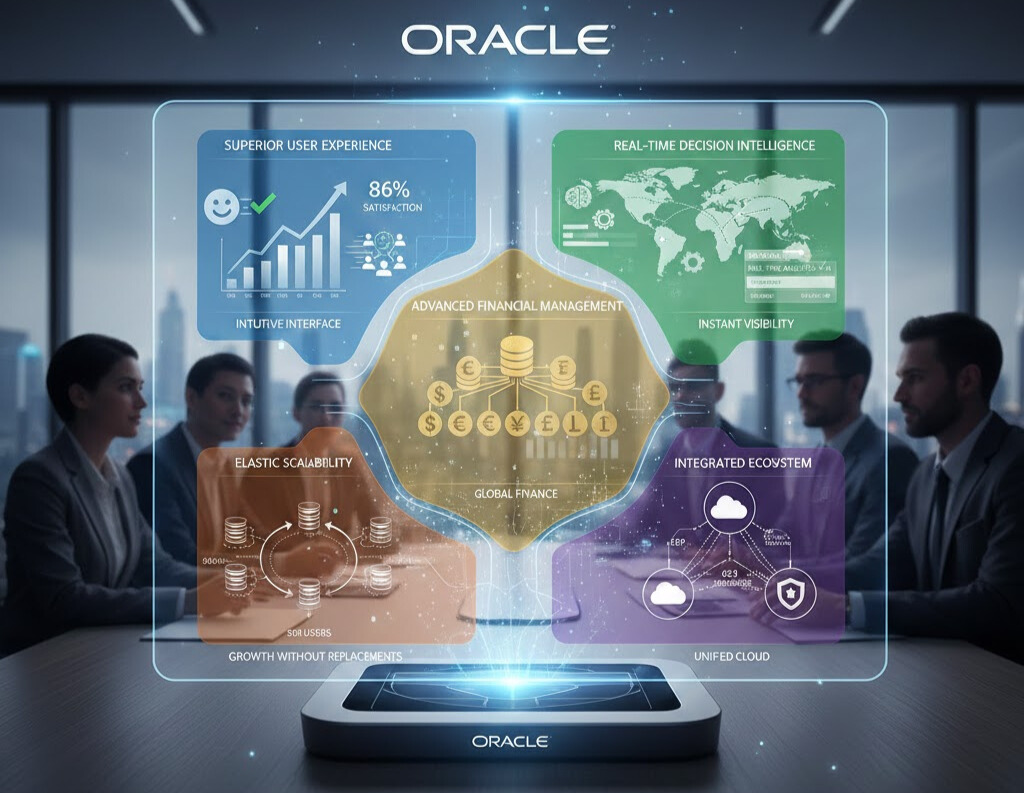
Oracle has fundamentally transformed the ERP landscape with its Oracle Fusion Cloud ERP platform, now commanding $8.7 billion in annual ERP revenues and serving over 14,000 large enterprises globally. The strategic shift of industry leaders—from JPMorgan Chase and Bank of America in finance to FedEx and UPS in logistics to the NHS in healthcare—reflects Oracle’s compelling value proposition.
Superior User Satisfaction & Ease of Use: Oracle Cloud ERP demonstrates significantly higher user satisfaction rates, with 86% of Oracle users reporting over 50% satisfaction levels, compared to only 44% of SAP users. This disparity stems from Oracle’s cloud-native architecture designed from inception for intuitive interfaces, responsive performance, and seamless user experiences. Organizations like Kroger and Lowe’s report faster employee adoption, reducing training costs and accelerating time-to-value.
Real-Time Analytics & Decision Intelligence: Enterprise leaders depend on instantaneous visibility into operations. Oracle Fusion Cloud provides real-time dashboards, embedded artificial intelligence, and predictive analytics that enable executives at JPMorgan Chase to monitor global transactions instantaneously, at Humana to optimize healthcare claims processing, and at FedEx to track package movements across the entire global network. The platform’s in-database machine learning capabilities automatically surface anomalies and opportunities without requiring separate BI tool deployments.
Advanced Financial Management: For global enterprises managing multi-currency operations, intercompany transactions, and consolidated reporting across dozens of subsidiaries, Oracle Fusion Cloud delivers unmatched capabilities. Financial services firms like Bank of America leverage Oracle’s integrated subledger accounting, automated revenue recognition (ASC 606 compliant), and cash management tools. The platform’s ability to handle complex consolidation scenarios—whether managing 100 or 10,000 entities—justifies its premium positioning among large financial institutions.
Scalability Without Rip-and-Replace: Unlike traditional ERP systems requiring costly overhauls as organizations grow, Oracle Cloud’s infrastructure scales elastically. From 500 to 500,000 users, organizations enjoy consistent performance without expensive system replacements. This elasticity appeals to rapidly growing technology companies and global enterprises expanding into new markets.
Integrated Cloud Ecosystem: Oracle’s strategic advantage extends beyond ERP. Organizations choosing Oracle Fusion Cloud gain integrated access to Oracle Cloud Infrastructure (OCI), Oracle Analytics Cloud, and Oracle Autonomous Database. This integrated ecosystem eliminates data silos and reduces costs associated with point solutions. Meta, one of the world’s largest technology companies, leverages this integrated ecosystem to align financial and operational systems with its cloud infrastructure strategy.

SAP S/4HANA, while recently surpassed by Oracle in total revenues, remains the dominant platform for manufacturing, logistics, and global supply chain operations, serving over 141,000 customers and maintaining the highest installed base among enterprise organizations. The loyalty of the world’s largest manufacturers—Toyota, Volkswagen, Bosch Group, Siemens—and retailers—Walmart, Costco, Carrefour, Schwarz Group—reflects SAP’s unmatched strengths in these verticals.
Manufacturing & Production Excellence: SAP S/4HANA delivers industry-leading capabilities for discrete and process manufacturing. Its production planning (PP), manufacturing execution systems (MES), quality management (QM), and demand-driven supply chain tools are unmatched. Volkswagen manages production across 123 facilities on six continents using SAP’s integrated planning. Toyota optimizes global supply chains involving thousands of suppliers using SAP’s advanced planning and optimization modules. These capabilities drive measurable competitive advantage in capital-intensive industries.
Supply Chain Visibility & Resilience: Global supply chain disruptions demand real-time visibility. SAP provides end-to-end transparency from raw material sourcing through final delivery. Walmart’s massive supply chain—serving 10,000+ stores globally—depends on SAP to coordinate millions of SKUs across the network. The platform’s integration with SAP Ariba for procurement and supplier collaboration creates closed-loop supply chain management unavailable in competing platforms.
Massive Installed Base & Ecosystem: SAP’s 40-year history created an unparalleled ecosystem of 15,000+ implementation partners, thousands of specialized add-on vendors, and extensive talent market. For large enterprises, this ecosystem reduces implementation risk and ensures sustained support. Microsoft, despite using Oracle for some workloads, maintains massive SAP S/4HANA deployments because of SAP’s manufacturing and supply chain depth.
Industry-Specific Pre-Configuration: SAP provides pre-configured industry solutions for over 30 verticals including automotive, pharmaceuticals, oil & gas, utilities, and public sector. This pre-configuration accelerates implementations from 18+ months to 12-15 months, delivering faster ROI. Carrefour’s retail operations benefit from SAP’s retail-specific functionality for omnichannel commerce, workforce management, and inventory optimization.
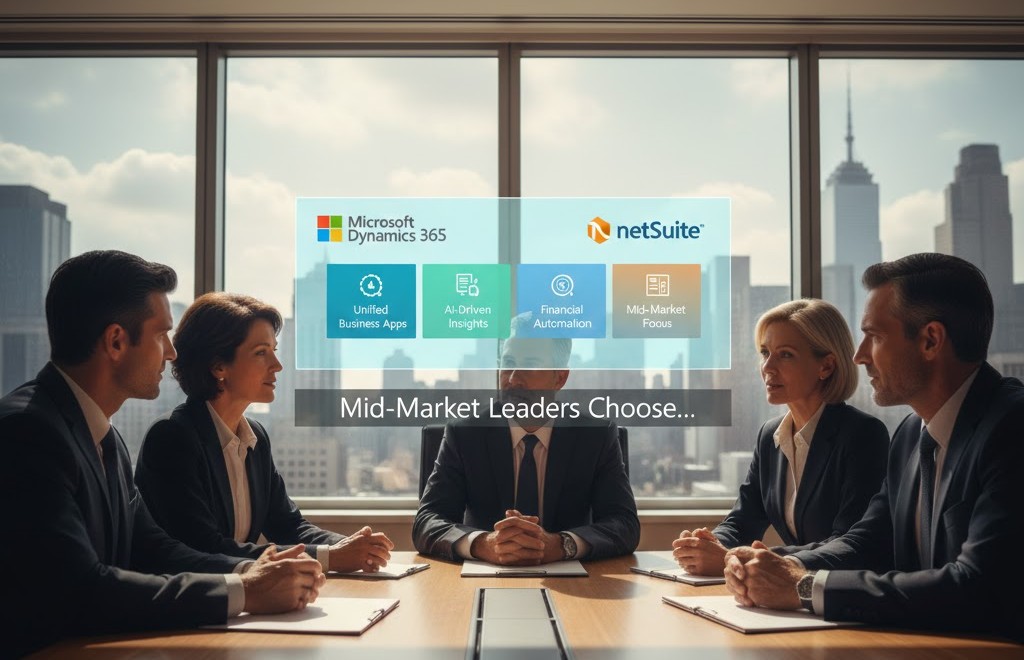
Microsoft Dynamics 365 Finance & Operations appeals to mid-market and large enterprises already invested in the Microsoft ecosystem (Office 365, Teams, Power BI). Its 25.74% market share by customer count (over 48,000 customers) reflects strong mid-market penetration. NetSuite, serving over 41,000 customers—predominantly small-to-mid-size businesses—commands approximately 10% of all cloud ERP deployments and 30% of the midsize business segment.
Microsoft Dynamics 365: Ecosystem Integration: Organizations standardized on Microsoft—from Microsoft 365 productivity apps to Azure cloud infrastructure to Power BI analytics—find Dynamics 365 integrates seamlessly. Real-time data flows from ERP to Power BI dashboards used throughout the organization. Teams collaboration integrates with business processes. This ecosystem integration eliminates data silos and delivers faster insights at lower cost than implementing separate best-of-breed platforms.
NetSuite: Cloud-Native Simplicity & Speed: NetSuite’s true cloud-native architecture—built on Java and cloud infrastructure from inception—delivers advantages over competitors retrofitting legacy on-premises systems. Implementation timelines of 4-6 months versus 12-18 months enable rapid value realization. Organizations growing 30-50% annually appreciate NetSuite’s elastic scalability. The platform’s strength in software, SaaS, and technology sectors reflects built-in functionality for subscription billing, revenue recognition (ASC 606), and cloud-based delivery models. NetSuite’s 25% year-over-year growth rate indicates strong market momentum, and with over 40,000 customers, the platform demonstrates mature functionality and ecosystem support.
Conclusion: Selecting Your Strategic ERP Partner
The $81.15 billion ERP market in 2024 and its projected growth to $229.79 billion by 2032 reflect enterprise resource planning’s fundamental importance to modern business operations. Oracle’s historic surpassing of SAP as the No. 1 ERP vendor demonstrates that the market remains dynamic, with innovation in cloud technology, user experience, and integrated ecosystems reshaping competitive positioning.
Your ERP selection should align with your industry, company size, strategic priorities, and existing technology investments:
- Global manufacturing and supply chain leaders: SAP S/4HANA remains optimal despite Oracle’s market leadership
- Financial services, healthcare, and data-driven enterprises: Oracle Fusion Cloud delivers superior real-time analytics and user experience
- Mid-market enterprises standardized on Microsoft: Dynamics 365 provides ecosystem integration advantages
- Rapidly scaling technology and SaaS companies: NetSuite enables fastest cloud deployment and subscription billing functionality
The most successful ERP implementations treat selection as a strategic business decision rather than a technology procurement. Engage executive leadership, allocate sufficient implementation resources, prioritize change management, and maintain realistic expectations about transformation timelines. Organizations that execute disciplined ERP implementations capture 200-300% cumulative two-year ROI through cost reduction, operational efficiency, and improved working capital management.
Discover the Right ERP for Your Organization
Schedule a complimentary consultation with our ERP advisory team. We help organizations like yours evaluate platforms, develop implementation roadmaps, and maximize value from your enterprise resource planning investment.
FAQs (Frequently Asked Questions)
What is an ERP system and why is it important?
An ERP (Enterprise Resource Planning) system integrates all business functions—finance, HR, supply chain, sales, and more—into one platform. It improves efficiency, eliminates data silos, and enables real-time decision-making, making it essential for businesses of all sizes.
Why did Oracle surpass SAP as the top ERP vendor?
Oracle led due to faster cloud adoption, higher revenue per customer, and a fully integrated cloud ecosystem. SAP remains strong in manufacturing and supply chain sectors.
How common are cloud-based ERP deployments?
Around 70% of global ERP systems are cloud-based, offering faster implementation, lower IT costs, and scalability. Some regulated industries still use on-premises solutions for compliance.
How long does ERP implementation take?
-
NetSuite: 4–6 months
-
Microsoft Dynamics 365: 6–10 months
-
SAP S/4HANA Cloud: 10–15 months
-
Oracle Fusion Cloud: 12–18 months
Factors include company size, legacy systems, and process complexity. Cloud solutions are generally faster.
What ROI can companies expect?
Most see measurable ROI in 12–18 months:
-
15–30% operational cost reduction
-
10–25% better working capital
-
25–40% labor efficiency gain
-
Faster financial close (50–80%)
Two-year ROI can reach 200–300% or more.
ERP comparison: SAP vs. Oracle vs. Microsoft
-
SAP S/4HANA: Best for manufacturing, supply chain, capital-intensive industries.
-
Oracle Fusion Cloud: Strong in finance, healthcare, real-time analytics.
-
Microsoft Dynamics 365: Affordable, integrates with Microsoft tools, ideal for mid-market.
-
NetSuite: Fastest cloud deployment for growing SMBs and SaaS.
How to migrate from legacy systems?
Use a phased approach: assess needs → pilot → data prep → process redesign → parallel run → cutover → stabilization. Large enterprises often roll out ERP in stages to avoid disruptions.
Key security and compliance features:
Encryption, multi-factor authentication, role-based access, audit trails, automated compliance, disaster recovery, and SOC 2 Type II certification.
Which industries suit which ERP?
-
SAP: Automotive, manufacturing, pharmaceuticals, utilities.
-
Oracle: Finance, healthcare, telecom, government.
-
Microsoft Dynamics: Mid-market, professional services, small manufacturers.
-
NetSuite: Tech companies, SaaS, SMBs needing rapid cloud deployment.
Common ERP failure factors & mitigation:
- Failures: Poor change management, unrealistic scope, weak executive support, poor data, vendor misalignment, over-customization.
- Mitigation: Strong executive sponsorship, phased rollout, thorough change management, data cleansing, clear vendor governance, minimize customizations, regular risk checks.