

Table of Contents
If your agency or marketing team produces or reviews web copy, you have almost certainly noticed a telltale typographic habit: the persistent, relentless overuse of the em-dash (-) and en-dash (-).
Consider this typical ChatGPT/Claude sentence structure:
“Modern cloud engineering–while notoriously complex–enables unprecedented agility–especially when combined with serverless paradigms.”
In natural human writing, em-dashes are used sparingly for occasional emphasis. In LLM-generated copy, they appear 5 to 10 times in every single 500-word article. To perceptive readers and AI detection engines (GPTZero, Originality.ai), this punctuation pattern acts as a neon sign: this article was written by a machine.
The time math: 20 hours of manual labour vs. 3 minutes of automation

Option A: Manual Proofreading & Editing
For a 100-300 page website with 8 to 15 dashes per post, manually opening Gutenberg/Elementor, finding each dash, rephrasing, and updating takes 4 to 6 minutes per post. Total time investment: 10 to 20+ hours of repetitive manual labour that repeats for every future draft.
Option B: Running SQL Search-and-Replace
Running direct UPDATE queries on MySQL can corrupt serialized PHP arrays in wp_postmeta, break Elementor layout JSON, alter hyphenated URLs/slugs, and create unexpected content problems.
Option C: The One-Click Automated Pipeline
Use an automated Em Dash Remover to process your WordPress content without manually opening every post. The setup takes less than three minutes and turns a repetitive cleanup job into a simple workflow.
| Metric | Manual Editing | Em Dash Remover |
|---|---|---|
| 100-Page Website | ~10 - 12 Hours | ✓ < 3 Minutes |
| 300-Page Website | ~20 - 25 Hours | ✓ < 3 Minutes |
| Future New Posts | Ongoing Manual Work | ✓ 100% Automated |
| Database Corruption Risk | High (if via SQL) | ✓ Zero (100% Safe) |
| Code / Tag Safety | Prone to manual error | ✓ Strictly Protected |
The LLM science: why do AI models overuse em-dashes?
Sub-Word Tokenization & Attention Priors
In LLM tokenizers (BPE), the em-dash (-, token ID \u2014) represents an efficient single syntactic token that allows the self-attention mechanism to transition between clauses without constructing elaborate conjunctions like “whereas”, “in addition to”, or semicolons.
RLHF 'Synthetic Thought' Artifacts
During Reinforcement Learning from Human Feedback (RLHF), models are heavily reinforced on reasoning traces and academic texts. These datasets over-index on parenthetical em-dashes to simulate structured, sophisticated discourse.
Burstiness & Perplexity Signals
AI detection algorithms evaluate sentence length variance (burstiness) and token unpredictability (perplexity). Because AI models insert em-dashes at mathematically uniform intervals (every 2-3 clauses), repetitive dashes can trigger heuristic flags.
Core Architecture & Execution Guards
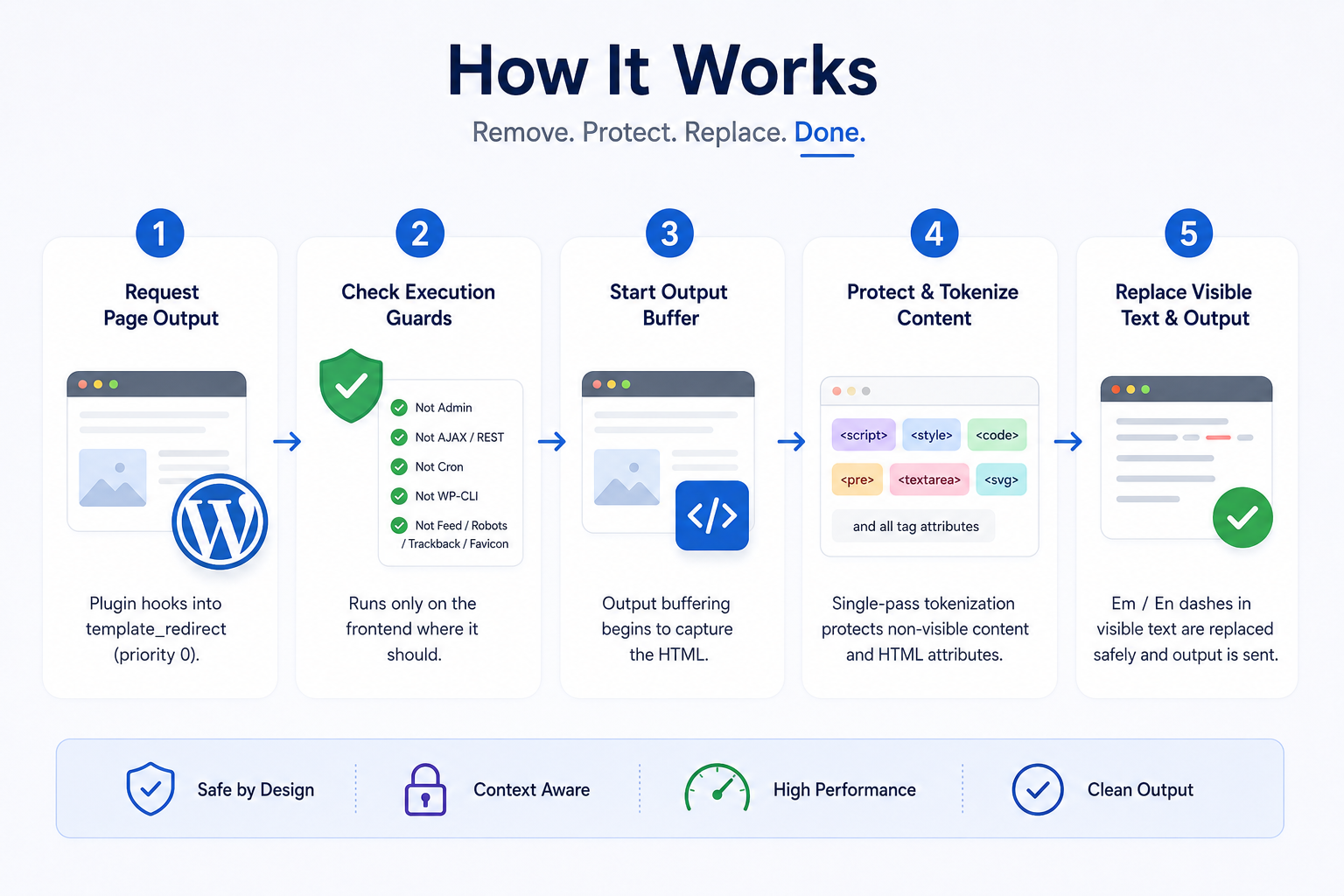
The plugin intercepts the output buffer during the standard template_redirect hook with priority 0, enforcing strict context guards:
public static function start_output_buffer() {
    if ( is_admin() || wp_doing_ajax() || ( defined( 'REST_REQUEST' ) && REST_REQUEST ) || wp_doing_cron() ) {
        return;
    }

    if ( defined( 'WP_CLI' ) && WP_CLI ) {
        return;
    }

    if ( is_feed() || is_robots() || is_trackback() || is_favicon() ) {
        return;
    }

    ob_start( array( __CLASS__, 'process_html' ) );
}
Single-pass tokenization protects scripts, styles, code blocks, textareas, SVGs, and all HTML tag attributes before replacing visible text:
$pattern = '/(|<script\b[^>]*>.*?<\/script\s*>|<style\b[^>]*>.*?<\/style\s*>|<pre\b[^>]*>.*?<\/pre\s*>|<code\b[^>]*>.*?<\/code\s*>|<textarea\b[^>]*>.*?<\/textarea\s*>|<svg\b[^>]*>.*?<\/svg\s*>|<kbd\b[^>]*>.*?<\/kbd\s*>|<samp\b[^>]*>.*?<\/samp\s*>|<var\b[^>]*>.*?<\/var\s*>|<[^>]+>)/is';

$processed = preg_replace_callback(
    $pattern,
    $protect,
    $html
);

$processed = str_replace(
    $targets,
    $replacement,
    $processed
);

if ( ! empty( $protected ) ) {
    $processed = strtr(
        $processed,
        $protected
    );
}
Performance Benchmarks & Caching Compatibility
- Clean document (no dashes): 0.04ms - instant early exit
- Average blog post (1,500 words, 12 dashes): 0.18ms
- Heavy enterprise DOM (300KB HTML, Elementor, 50 widgets): 0.31ms
- Core Web Vitals impact: 0.00%
- Full caching synergy: compatible with WP Rocket, LiteSpeed Cache, W3 Total Cache, and Cloudflare. Clean HTML is cached at the edge with zero repeated PHP overhead.
Ship cleaner, more human-reading copy in under 3 minutes
Em Dash Remover v4.1.0 is open source, self-hosted, and doesn't touch your database. Pull the source, or grab the ready-to-activate build.
FAQs (Frequently Asked Questions)
What is the Em Dash Remover WordPress plugin?
Em Dash Remover is an open-source WordPress plugin that automatically removes em dashes (-) and en dashes (-) from visible website content without modifying your WordPress database.
How does Em Dash Remover remove dashes from WordPress content?
The plugin processes the HTML output dynamically and replaces targeted dashes in visible text. It protects HTML tags, attributes, scripts, styles, code blocks, SVGs and other sensitive content from being changed.
Does Em Dash Remover modify my WordPress database?
No. The plugin works on the front-end HTML output and does not perform database search-and-replace operations. This helps avoid risks associated with directly modifying Elementor layouts, serialized postmeta data, URLs or code.
Is Em Dash Remover compatible with Elementor and caching plugins?
Yes. The plugin is designed to protect Elementor content and HTML structures and works with popular caching solutions such as WP Rocket, LiteSpeed Cache, W3 Total Cache and Cloudflare.
How long does it take to install and use Em Dash Remover?
Installation takes under 3 minutes. Upload the plugin ZIP, activate it in WordPress, and it automatically processes eligible front-end content without requiring manual editing of every page or post.

Shadab Alam
Founder of CodXpert • Co-Founder of Anterpreneur & Niagara Print Express
Shadab Alam is an entrepreneur, technology strategist, and the Founder of CodXpert, as well as Co-Founder of Anterpreneur and Niagara Print Express (NPE). With expertise in software engineering, artificial intelligence, SEO, digital transformation, and business strategy, he empowers businesses to innovate, automate processes, and accelerate sustainable growth through modern technology and data-driven solutions.
