

Table of Contents
Why Is Your Foreign Wire Sitting on Hold?
If you run an IT agency, export custom software, or work as an independent digital consultant in India, you have likely encountered this frustrating scenario:
Your client in the United States, Europe, or the United Arab Emirates wires your milestone payment. You track the payment and confirm it has left their overseas account. But instead of the funds crediting to your Indian current account, your relationship manager at HDFC Bank, ICICI Bank, or SBI sends you an urgent email with an attached Excel template titled:
“Declaration cum Request Letter under FEMA 23(R) / Export Declaration Form (EDF)”
Your bank informs you that unless this declaration is signed, stamped, and returned with cross-referenced invoice PDFs, your inward remittance cannot be disposed of and risks being held in Nostro intermediary accounts or returned to the remitter.
Why do Indian banks demand this paperwork for routine software and service exports? What is FEMA 23(R), and how do you navigate it without hours of manual spreadsheet headaches? In this comprehensive statutory guide, we break down everything you need to know about FEMA 23(R) declarations, SAC code mappings, purpose codes, and how to maintain an unbroken audit trail from invoice creation to DGFT e-BRC self-certification.
What Is FEMA 23(R)? The Legal Framework
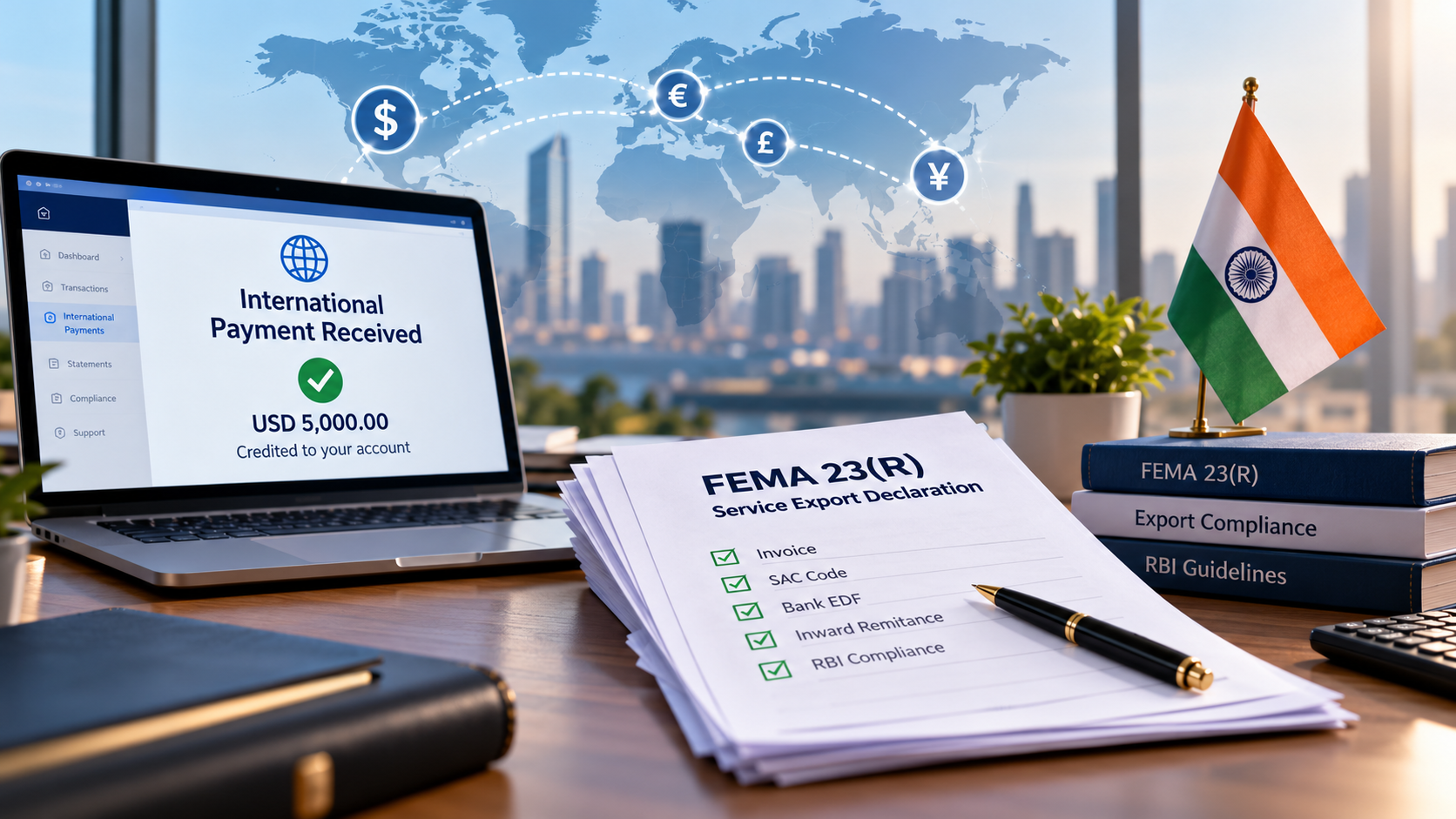
FEMA 23(R) refers to the Foreign Exchange Management (Export of Goods and Services) Regulations, 2015, notified by the Reserve Bank of India under notification FEMA 23(R)/2015-RB.
The regulation governs how Indian individuals, partnerships, LLPs, and private limited companies realize and repatriate foreign exchange earned through cross-border trade.
To understand why service exporters must submit these bank declarations, you have to look at the structural difference between goods and services:
- Physical Goods Export: When physical merchandise leaves an Indian sea port or airport, customs officials generate an electronic Shipping Bill. This Shipping Bill automatically flows into the RBI Export Data Processing and Monitoring System (EDPMS) to track statutory realization.
- Services and Digital Export: When a software engineer commits code to a remote GitHub repository, or an agency delivers a digital marketing campaign over the web, no physical customs shipping bill exists.
To fulfill statutory compliance under Regulation 3 and Regulation 6 of FEMA 23(R), Authorized Dealer Category-I (AD Cat-I) banks are legally mandated by the RBI to collect a formal Service Export Declaration Form and Customer Request Letter from the beneficiary before releasing foreign exchange into your account.
Furthermore, under Regulation 9 of FEMA 23(R), exporters are legally required to realize the full value of exported goods and services within 9 months from the date of the invoice, unless a formal extension is granted by the bank or the RBI.
FEMA 23(R) Bank Declaration vs STPI Softex Form: Which One Do You Need?
A major source of confusion among technology founders and freelancers is whether they must register with the Software Technology Parks of India (STPI) to file a Softex form, or if the bank FEMA declaration is sufficient.
Here is a clear comparison table to eliminate the confusion:
| Comparison Factor | STPI Softex Form | Bank FEMA 23(R) Declaration |
|---|---|---|
| Governing Body | STPI / SEZ Development Commissioner | Authorized Dealer Bank / RBI |
| Applicability | Packaged software products, registered STPI units | Custom software, IT consulting, SaaS, design, marketing |
| Exporter Registration | Mandatory Non-STPI or STPI registration | Any registered Indian business, LLP, or proprietorship |
| Submission Window | Within 30 days of the invoice date | At or before inward remittance disposal |
| Target Exporter | Pure software product houses with STPI licenses | Freelancers, digital agencies, remote consultants |
| Filing Platform | STPI online portal (softex.stpi.in) | Bank portal or signed Excel declaration workbook |
The Practical Rule of Thumb:
If you provide custom web development, mobile apps, DevOps consulting, digital marketing, or remote engineering without being an STPI-registered unit, your Authorized Dealer bank’s FEMA 23(R) Service Export Declaration is the legally prescribed mechanism to clear your inward foreign remittances.
Breakdown of the Bank FEMA 23(R) Declaration Package
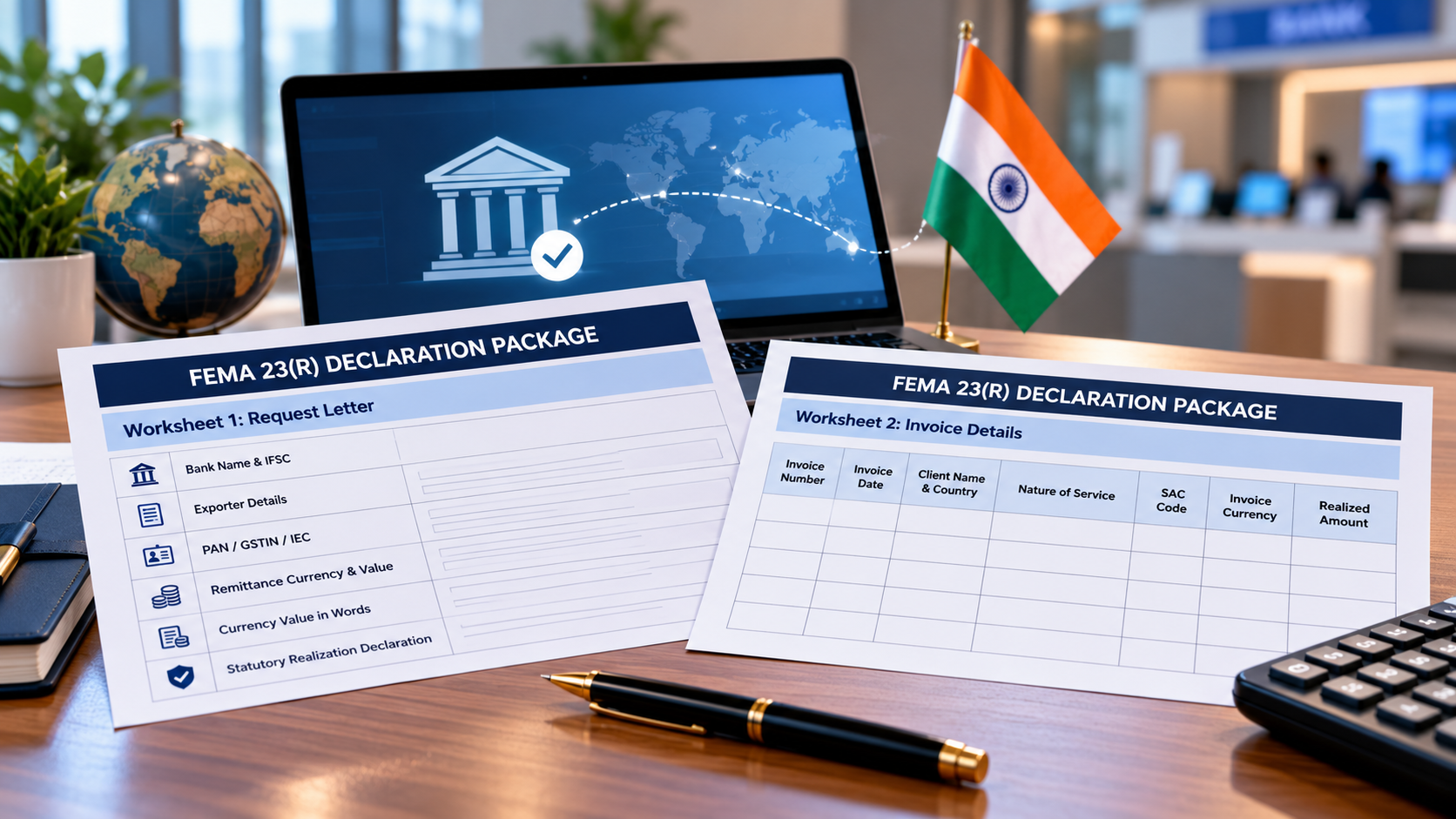
While formatting varies slightly between institutions (such as HDFC Bank, ICICI Bank, or State Bank of India), the statutory FEMA declaration workbook consists of two primary worksheets that must cross-reconcile with 100 percent accuracy:
Worksheet 1: Request Letter (Covering Mandate)
This worksheet functions as your legal instruction to the bank to convert the incoming foreign currency wire and credit the net proceeds to your Indian current or EEFC account. It includes:
- Authorized Dealer Branch Name and IFSC / Swift Code.
- Exporter Details: Registered legal business name, complete physical address, PAN number, GSTIN, and Import Export Code (IEC).
- Remittance Currency and Value: The exact gross realized amount in foreign currency (for example: USD 12,450.00).
- Currency Value in Words: The mandatory legal representation in words (for example: USD Twelve Thousand Four Hundred Fifty and Cents Zero Only).
- Statutory Realization Declaration: An explicit confirmation that the remittance represents full realization of exported services within the 9-month window stipulated under Regulation 9 of FEMA 23(R).
Worksheet 2: Invoice Details (Line-Item Schedule)
This sheet breaks down the incoming wire by linking it to specific export invoices. It requires:
- Invoice Number and Invoice Date.
- Overseas Client Name and Full Physical Address (including client country).
- Nature of Service Provided: Clear description matching your contractual scope.
- GST Service Accounting Code (SAC): The statutory 6-digit code defining your service category.
- Invoice Currency and Realized Amount: Line-item foreign currency values matching the wire total.
Essential SAC Codes & RBI Purpose Codes for Technology Exporters
Using incorrect Service Accounting Codes (SAC) or mismatched RBI Purpose Codes can cause bank compliance rejections or trigger scrutiny during GST zero-rated refund audits. Always ensure your invoice SAC code matches your FEMA bank declaration:
| SAC Code | Official Service Description | Matching RBI Purpose Code | Typical IT / Agency Use Case |
|---|---|---|---|
| 998314 | IT Design & Development Services | P0802 | Custom software coding, web apps, mobile apps, frontend/backend engineering |
| 998313 | IT Infrastructure & Network Management | P0801 | DevOps engineering, AWS/GCP cloud management, server security auditing |
| 998311 | Management & Technical Consulting | P0802 | Fractional CTO advisory, system architecture planning, agile strategy |
| 998315 | Hosting & Infrastructure Provisioning | P0803 | SaaS platform subscriptions, managed cloud database hosting |
| 998361 | Digital Marketing & Advertising | P1007 | SEO consulting, PPC campaigns, conversion rate optimization, content marketing |
| 998391 | Specialty Design Services | P0802 | Figma UI/UX design, brand design systems, web wireframing |
The Unbroken Compliance Chain: From Invoice to e-BRC
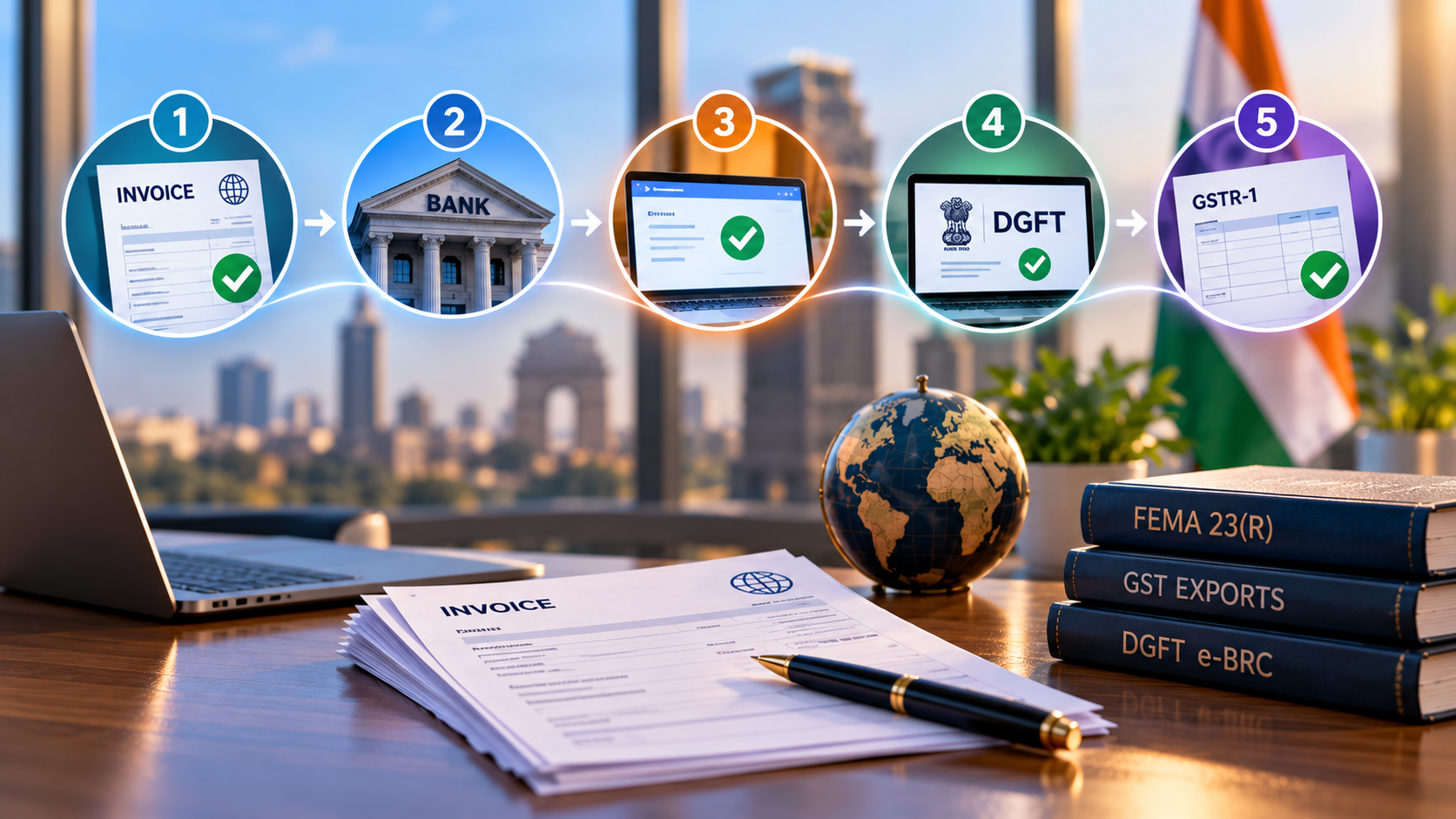
Under Section 16 of the Integrated Goods and Services Tax (IGST) Act, exported services are classified as Zero-Rated Supplies when executed under a valid Letter of Undertaking (LUT). To protect your zero-tax status from tax authorities and avoid FEMA penalties, you must maintain an unbroken 5-step compliance chain:
Step 1: Issue a GST LUT Compliant Export Invoice
Quote your valid LUT ARN number, correct 6-digit SAC code, complete overseas client address, and foreign currency value. Never bill export services without a valid LUT in place.
Step 2: Submit the FEMA 23(R) Bank Declaration
Provide your completed bank declaration workbook alongside the export invoice PDF to your Authorized Dealer bank as soon as the wire arrives.
Step 3: Bank Disposes Funds & Generates Inward Remittance Message (IRM)
Once verified, the bank credits your account and logs the foreign wire in the RBI trade system, generating an official Inward Remittance Advice (FIRA) with a unique IRM number. Read our FIRC & Inward Remittance Reconciliation Guide.
Step 4: Self-Certify Your e-BRC on the DGFT Portal
Log in to the Directorate General of Foreign Trade (dgft.gov.in) portal, navigate to e-BRC Self-Certification, link your IRM reference number to your invoice number, and digitally sign your certificate.
Step 5: Report Export Invoices on GSTR-1 (Table 6A)
Report the invoice under Table 6A of your monthly GSTR-1 as WOPAY (Export without payment of tax), ensuring the rupee value aligns with statutory exchange rates. Read our GSTR-1 Export Invoice Filing Guide.
The 4 Costly Mistakes That Cause Payment Holds
Foreign exchange compliance teams at Authorized Dealer banks reject declarations for four recurring reasons. Avoid these common operational traps:
1. Third-Party Remitters
If your invoice is addressed to Acme Tech Inc (USA), but the foreign wire arrives from Acme Holding Global Ltd (UK) without pre-submitted contractual proof of relationship, the bank will freeze the funds under Anti-Money Laundering (AML) regulations. Always ensure the remitting entity matches your invoice client name.
2. Unaccounted Intermediary Bank Wire Deductions
If your invoice total is $5,000, but your bank receives $4,975 due to a $25 intermediary correspondent bank deduction, your declaration must balance. You must account for the $25 as bank charges; otherwise, an unexplained $25 open balance remains on the invoice.
3. Missing Client Physical Address
FEMA regulations strictly mandate identifying the destination country and physical location of service consumption to confirm genuine cross-border supply. Invoices listing only an email address will be flagged by bank audit teams.
4. Exceeding the 9-Month Realization Period
Under Regulation 9 of FEMA 23(R), export proceeds must be realized within 9 months. If an overseas client pays an invoice 10 months after issuance, your bank cannot clear the funds without a formal extension request or RBI approval.
How CodXpert Invoices Automates FEMA Compliance
Manually filling out bank Excel templates, converting currency amounts to words, looking up SAC codes, and cross-checking invoice dates for every foreign wire is time-consuming and prone to human error.
CodXpert built its dedicated invoicing software, CodXpert Invoices (https://invoice.codxpert.com/), specifically to solve these compliance headaches for Indian IT agencies, software developers, and consultants:
1-Click Bank-Ready FEMA 23(R) Export
Automatically generate pre-filled HDFC and standard bank declaration workbooks with both the Request Letter and Invoice Details worksheets formatted to bank specifications.
Automated Currency Numbers-to-Words Engine
Converts foreign currency totals into precise legal word representations (for example: USD Fourteen Thousand Two Hundred and Cents Fifty Only) without manual typing.
Multi-Invoice Consolidation
If an international client pays multiple milestone invoices in a single bank wire, select all matching invoices in your dashboard to generate an aggregated multi-row declaration instantly.
Native Excel Format Preservation
Maintains exact cell validations, dropdowns, and formatting formulas so your bank automated ingestion systems accept files without technical rejection.
Key Takeaways for Indian Service Exporters
- FEMA 23(R) requires Authorized Dealer banks to collect formal export declarations before clearing inward foreign currency remittances.
- Non-STPI software agencies and digital freelancers use bank FEMA declarations rather than STPI Softex forms.
- Always match your invoice SAC code (such as 998314) with the correct RBI purpose code (such as P0802).
- Maintain an unbroken audit trail: Export Invoice under LUT -> FEMA Bank Declaration -> IRM Generation -> DGFT e-BRC Self-Certification -> GSTR-1 Table 6A.
FAQs (Frequently Asked Questions)
Is an Import Export Code (IEC) mandatory for software and service exporters?
While the DGFT exempts pure service exporters from holding an IEC if they do not claim foreign trade policy benefits, Authorized Dealer banks (such as HDFC and ICICI) almost universally require an IEC to log Inward Remittance Messages (IRMs) in automated trade portals. Obtaining an IEC takes under 15 minutes online at dgft.gov.in using your PAN and Aadhaar.
What RBI Purpose Code should software and IT companies use?
The standard RBI purpose code for software implementation and custom coding is P0802. For IT infrastructure, DevOps, and network management, use P0801. For cloud data processing and SaaS hosting, use P0803.
Can I combine multiple export invoices into a single FEMA declaration?
Yes. If an international client pays several open invoices or project milestones in one combined bank wire, you can list all corresponding invoices line by line in the Invoice Details worksheet of your declaration.
How do I handle payment gateway payouts from Stripe, PayPal, or Wise?
When using payment aggregators, foreign funds are collected by the aggregator and disbursed locally to your Indian bank. You must collect the consolidated Inward Remittance Advice or FIRC certificate directly from the payment provider to reconcile with your GST export invoices.
What happens if my overseas client delays payment past 9 months?
If an export invoice remains unpaid past 9 months, you must file a formal extension request with your Authorized Dealer bank before the deadline expires, explaining the commercial reason for the delay.
Streamline Your Export Billing and FEMA Compliance
Tired of manually wrestling with bank spreadsheets and foreign exchange compliance? Generate GST LUT compliant multi-currency export invoices and automated bank-ready FEMA 23(R) declarations in seconds with CodXpert Invoices.

Shadab Alam
Founder of CodXpert • Co-Founder of Anterpreneur & Niagara Print Express
Shadab Alam is an entrepreneur, technology strategist, and the Founder of CodXpert, as well as Co-Founder of Anterpreneur and Niagara Print Express (NPE). With expertise in software engineering, artificial intelligence, SEO, digital transformation, and business strategy, he empowers businesses to innovate, automate processes, and accelerate sustainable growth through modern technology and data-driven solutions.
