
Table of Contents
When building a mobile application for iOS and Android, creating two separate native apps in Swift and Kotlin is an expensive luxury that most startups cannot afford. Building separate codebases doubles your developer payroll, slows feature releases, and creates inconsistent user experiences between iPhone and Android users.
Cross-platform mobile frameworks solve this problem by allowing engineering teams to ship to both app stores from a single unified codebase. For years, the two undisputed market leaders have been Google’s Flutter and Meta’s React Native.
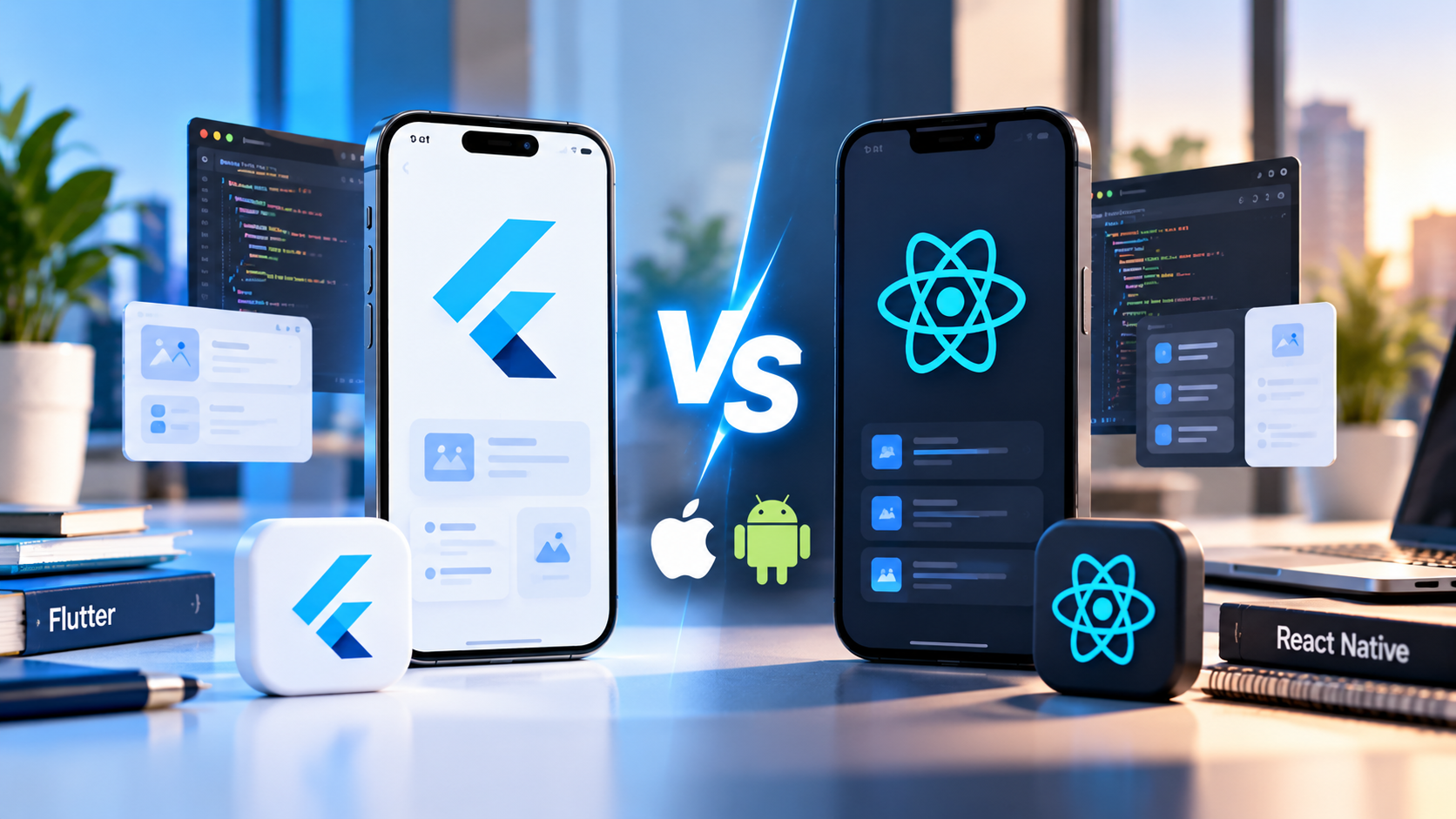
Both frameworks power multi-million user apps worldwide, but their underlying architectures, performance characteristics, and developer ecosystems differ significantly. Here is an honest, practical engineering guide to help startup founders choose the right framework in 2026.
Core Architectural Difference: How They Draw Screens
Google Framework
Flutter
Flutter uses its own rendering engine to draw the user interface, giving developers precise control over visual consistency across iOS and Android.
How It Works
- ✓ Renders interface elements through Flutter's graphics and widget system.
- ✓ Supports consistent layouts, custom animations, and branded interfaces.
- ✓ Uses Dart and a shared codebase for supported mobile platforms.
- ✓ Well suited to highly customized, visually consistent applications.
Meta Framework
React Native
React Native lets developers build mobile applications with JavaScript or TypeScript while using native platform UI components through its rendering architecture.
How It Works
- ✓ Maps React components to native platform views.
- ✓ Supports platform-appropriate interface elements and interactions.
- ✓ Uses JavaScript or TypeScript with a shared mobile codebase.
- ✓ Fits teams already working with React and web technologies.
Performance & Animation Speed
How both frameworks handle speed, memory, and smooth scrolling:
- Flutter Performance: Because Flutter compiles directly to native ARM machine code without a runtime JavaScript bridge, it delivers rock-solid 60fps and 120fps animations. It handles data-dense charts, canvas games, and fluid transitions with virtually zero stutter.
- React Native Performance: React Native has closed the performance gap with its New Architecture (Hermes engine and Fabric renderer). However, applications handling intense background processing or heavy continuous animations can still experience minor frame drops compared to Flutter.
Developer Talent & Ecosystem Maturity
Evaluating developer availability and package libraries in 2026:
React Native Advantage
- Built with JavaScript and TypeScript.
- Access to a large and established developer community.
- Existing React developers can transition to mobile development more easily.
Flutter Advantage
- Uses Dart, a modern, statically typed programming language.
- Familiar concepts make it approachable for experienced developers.
- Offers an extensive package ecosystem through Google's pub.dev repository.

When Startups Should Choose Flutter
Scenarios where Flutter is the clearly superior technical choice:
- You need identical, pixel-perfect branding and custom UI across both iOS and Android platforms.
- Your mobile app requires heavy custom animations, financial charts, or interactive canvas elements.
- You are launching a brand new product from scratch and want fast widget-driven prototyping.
- You want your app to compile cleanly to native code with minimal dependency on third-party bridge libraries.
When Startups Should Choose React Native
Scenarios where React Native is the smarter commercial move:
- Your company already operates an existing web application built in React.js and wants to share state logic, utilities, and API models.
- Your team consists primarily of JavaScript/TypeScript developers.
- You plan to leverage Over-The-Air (OTA) updates (via Expo) to push instant bug fixes to users without waiting for App Store approval.
Key Takeaways
- Both frameworks cut mobile engineering costs by 30 to 40 percent compared to separate native apps.
- Choose Flutter if you prioritize smooth animations, custom UI consistency, and native ARM performance.
- Choose React Native if you have an existing React web platform and want to share engineering talent.
FAQs (Frequently Asked Questions)
Will Apple or Google reject apps built with Flutter or React Native?
No. Both Apple App Store and Google Play fully support and feature Flutter and React Native applications, including apps built by BMW, Alibaba, Shopify, and Google Pay.
Can Flutter and React Native access native phone hardware like GPS and camera?
Yes. Both frameworks provide complete access to smartphone cameras, location GPS, biometric sensors, Bluetooth, and local storage.
Which framework is easier to maintain long-term?
Flutter tends to have fewer breaking changes between version upgrades because Google manages both the language, rendering engine, and core widgets together.
Planning your mobile app build?
Explore CodXpert’s Flutter App Development Services, or learn more about our React.js Development capabilities for web and mobile.

Shadab Alam
Founder of CodXpert • Co-Founder of Anterpreneur & Niagara Print Express
Shadab Alam is an entrepreneur, technology strategist, and the Founder of CodXpert, as well as Co-Founder of Anterpreneur and Niagara Print Express (NPE). With expertise in software engineering, artificial intelligence, SEO, digital transformation, and business strategy, he empowers businesses to innovate, automate processes, and accelerate sustainable growth through modern technology and data-driven solutions.